



AI adoption statistics in the UK
• Is the UK leading in AI adoption?
• How much has AI contributed to the UK economy?
• Where are UK companies investing?
• How does the public feel about AI playing a larger role in everyday life and work?
Answers to these and other questions about UK AI adoption statistics are broken down in an AI adoption report from Vention, an AI-enabled software development company with 20+ years in the software engineering market.
About Vention, an AI-enabled software development company
Vention helps businesses structure their AI adoption and AI software development, making AI practical and measurable so it improves productivity without disrupting delivery or introducing new risks.
Rather than treating AI as a standalone tool, we integrate it across the software development lifecycle (SDLC), which keeps development controlled and predictable. Our focus is to deliver reliable software and give clients peace of mind throughout development.
Years of engineering experience proven by 550+ clients across the globe
Deep AI experience rooted in 150+ successful projects across industries
AI professionals with experience across MLOps, deep learning, NLP, computer vision, generative AI, and data engineering
Up to 15 per cent efficiency boost with our AI-enabled teams
Industries served, including UK fintech and healthcare
London-based CTO and client partners to ensure robust project oversight
Average client savings
ISO 27001-certified security management system to facilitate data safety and compliance
AI in the UK market: overview
The UK is the third-largest AI market globally, behind only the US and China. Step by step, AI investment is accelerating, enterprise adoption is growing, and productivity gains are becoming increasingly visible.

Estimated value of the UK AI market in 2025
Projected market value by 2033
AI companies operating in the UK
Potential productivity gains brought by AI adoption
How much investment did UK AI startups secure in 2025?
In 2025, UK AI startups secured 80% more funding than the previous year, which accounts for approximately 33% of all UK venture capital deployed.
During the year, investors completed 457 AI funding rounds. 67% of those funding rounds concentrated in London, reinforcing the city’s role as the country’s main AI investment hub.
Notable AI funding rounds in the UK in 2025 included:
- Kraken, the energy software platform
- NScale, an AI infrastructure provider
- Isomorphic Labs, the drug discovery company spun out of DeepMind
- Synthesia, the AI avatar startup
Year-over-year overview of the UK venture capital investment in core AI startups
2016
2017
2018
2019
2020
2021
2022
2023
2024
2025
Q1 2026
Percentage of the UK venture capital invested in core AI
2016
2017
2018
2019
2020
2021
2022
2023
2024
2025
Q1 2026
UK business expenditure on AI tools is accelerating
Over the past five years, 85% of UK organisations have reported a significant increase in spending on AI technologies. The shift suggests that early experimentation is giving way to sustained investment.
How much has AI expenditure increased over the last five years?
Change in AI expenditure | Share of organisations | |
|---|---|---|
01 | Increased by <10% | 7% |
02 | Increased by 10-19% | 5% |
03 | Increased by >= 20% | 73% |
04 | No change | 8% |
05 | Don’t know | 7% |
How many UK organisations use AI today?
Despite attracting quite strong investment, the adoption of artificial intelligence among UK businesses remains relatively modest. One in four businesses already use AI, but over half of organisations have no active plans to adopt AI.
of UK companies currently use one or more AI technologies
plan to adopt AI within the next three months
of UK businesses do not use AI in any form
cite data protection risks as the primary reason for delaying adoption

AI usage rates: UK workforce perspective
Among UK organisations that have adopted artificial intelligence, employee usage is steadily increasing. On average, 30% of staff in these companies actively use AI tools in their day-to-day work.
The benefits are already visible:
At the same time, new risks are emerging as AI becomes more common in the workplace:
say they couldn’t complete their work without AI help
ely on AI to complete tasks instead of learning how to do them
are concerned about falling behind if they do not use AI at work
have used AI at work in ways that may be inappropriate
How responsibly do UK employees use AI?
As AI adoption grows, concerns about responsible use are growing as well. Many AI tools rely on large language models and generative systems that can produce confident but flawed outputs if left unchecked. The data also shows that employees often rely on these tools too heavily.
The UK public attitudes towards AI: cautious optimism
Public sentiment towards artificial intelligence in the UK is controversial. Many people express concern about potential risks, but there is also clear recognition of AI’s potential benefits.
expect AI to deliver significant benefits
have personally experienced or observed positive outcomes from AI use
feel confident using AI tools effectively
accept or approve of AI in general

However, when it comes to employment and the broader economy, views are divided.
believe AI will improve the UK economy
believe the risks of AI outweigh the benefits
do not believe AI will replace their jobs
think AI will make the job market worse
The UK public prefers human-created content over AI-generated content
Outside of the corporate world, where AI is often deployed to drive efficiency and revenue, public preference remains firmly human. Across different contexts, people favour human judgement and creativity over AI-generated outputs.
Prefer human-created content | Prefer AI-generated content | |
|---|---|---|
Online news articles or websites | 78% | 11% |
Customer marketing websites | 65% | 16% |
Screening job applicants | 73% | 13% |
Assisting with order taking at restaurants | 68% | 16% |
AI’s growing sophistication is also fuelling concern, as automatically generated content becomes increasingly human-like.
- 72% are unsure whether online content can be trusted, as it may be AI-generated
- 54% are concerned about elections being manipulated by AI-generated content or bots
- 91% want stronger laws and action to combat AI-generated misinformation
AI adoption in the UK vs the EU: who’s taking the lead?
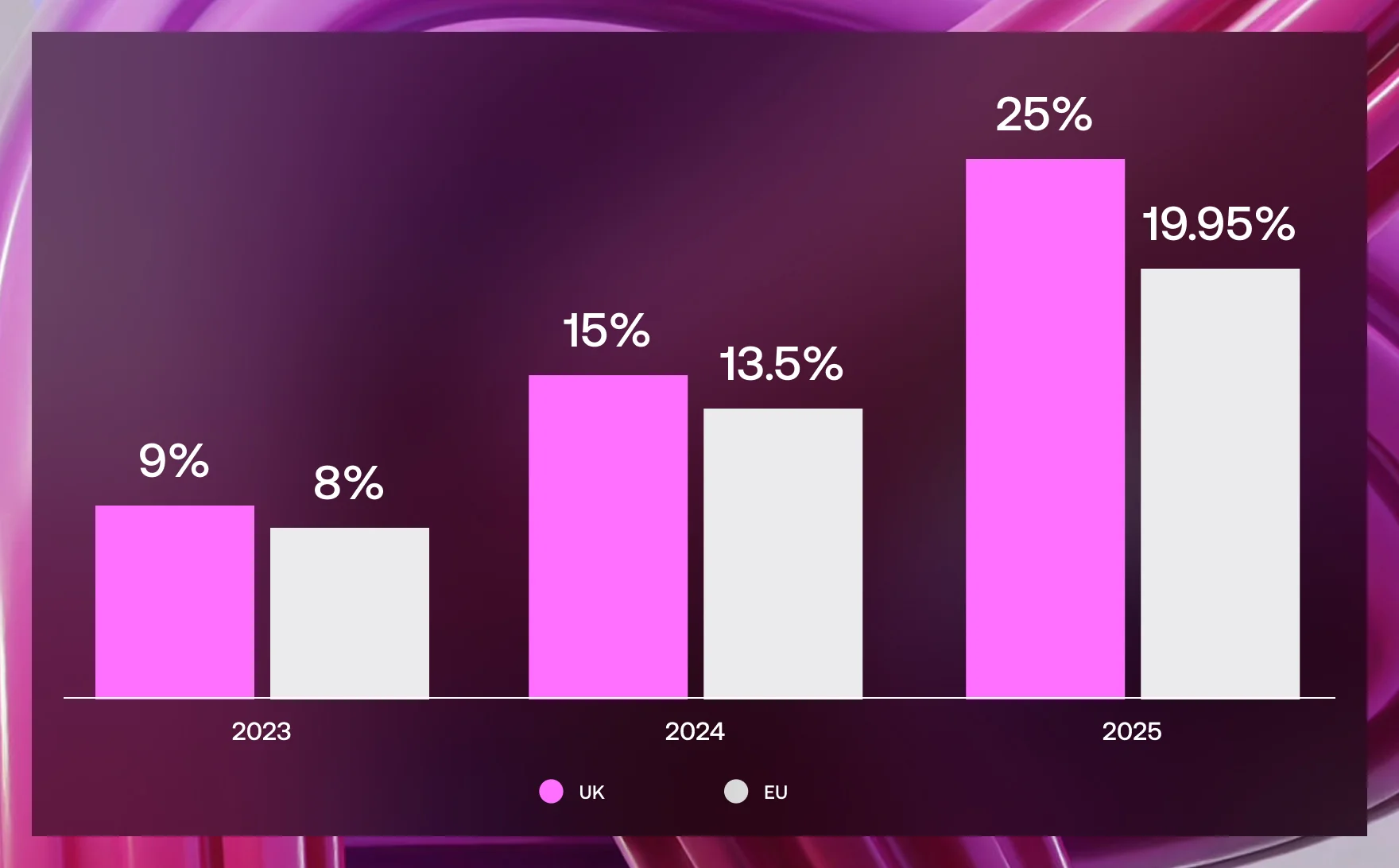
Year after year, the UK has outpaced the European Union in business adoption of artificial intelligence, reaching its highest point in 2025. In 2025, AI adoption among UK businesses was just over five percentage points higher than the EU average.
How does the US compare with the UK and the EU on AI adoption?
US businesses appear to lag behind both the UK and the EU in overall AI adoption in 2025, with adoption more than seven percentage points lower than in the UK.
Overall AI adoption rates among businesses, 2025
What’s being compared | AI adoption rate | |
|---|---|---|
UK | Businesses currently using some form of AI | 25% |
EU | Enterprises that used AI technologies in 2025 | 19.95% |
US | Businesses that used AI in the last two weeks in any business function (2025) | 18.2% |
The picture shifts when focusing on larger organisations with 250 or more employees.
UK
EU
US
AI adoption rates across UK industries: a widening sector divide
AI adoption in the UK is far from uniform. While technology-led, knowledge-intensive sectors are rapidly integrating AI into core workflows, traditional industries remain largely on the sidelines.
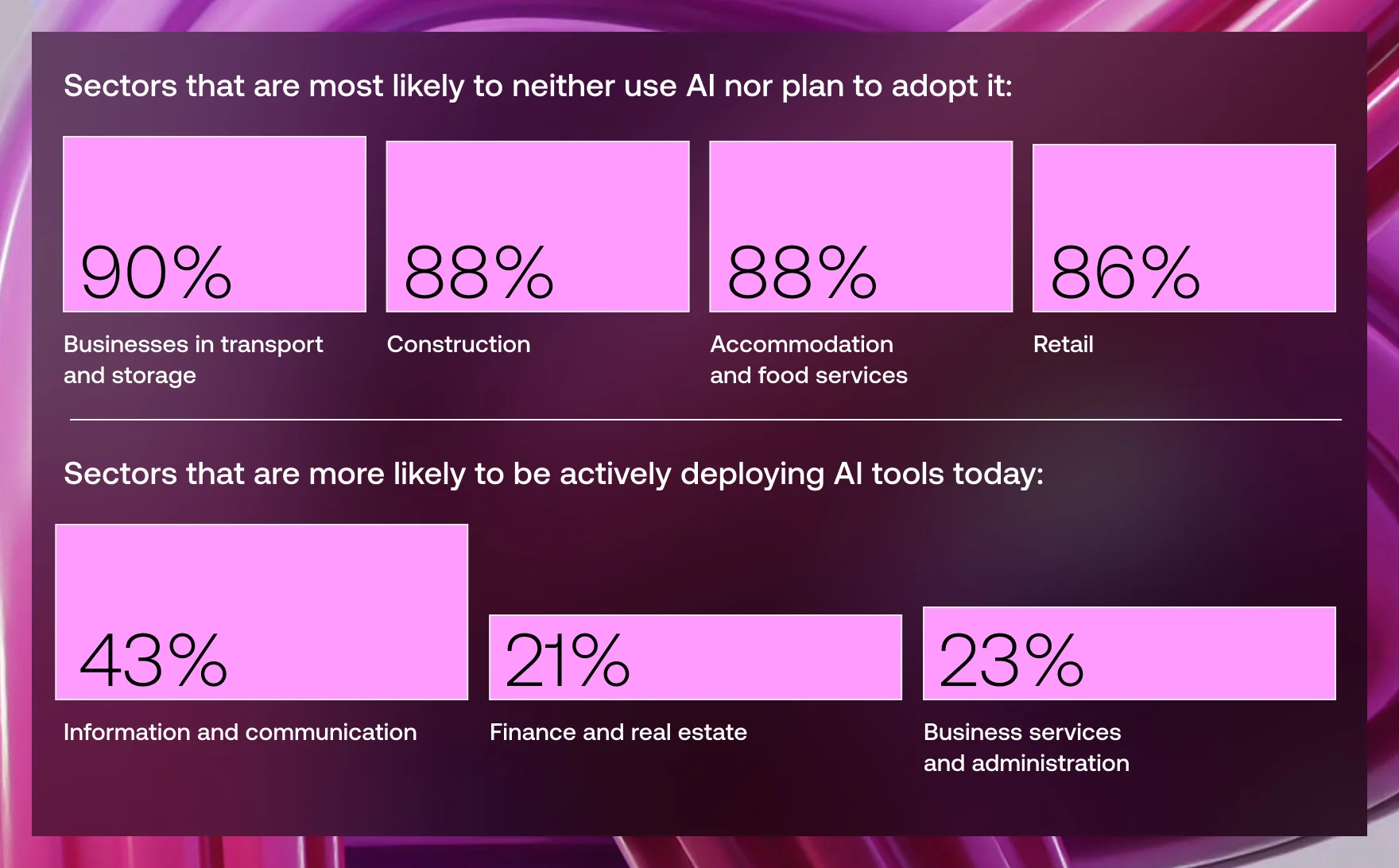
Types of AI technologies used by businesses across UK sectors
Data processing using ML | Image processing using ML | Robotics | Text generation using LLMs | Visual content creation | Business doesn’t currently use AI technologies | |
|---|---|---|---|---|---|---|
Manufacturing | 6.7% | 5% | 1% | 8.2% | 10.4% | 69.7% |
Construction | 5.8% | 3.9% | 0.0% | 3.4% | 6.8% | 80.6% |
Wholesale and retail trade; repair of motor vehicles and motorcycles | 5.1% | 1.6% | - | 8% | 11.1% | 71.1% |
Transportation and storage | - | 1.8% | 0.0% | - | - | 83.9% |
Accommodation and food service activities | 3.2% | - | - | 2.9% | 3.2% | 86.9% |
Information and communication | 18.4% | 13.6% | 2% | 32.9% | 24.3% | 46.8% |
Real estate activities | 4.2% | 7.9% | 0.0% | 20.5% | 16.8% | 65.2% |
Professional, scientific, and technical activities | 14.8% | 6.2% | - | 28.8% | 18.1% | 52.2% |
Administrative and support service activities | 3.4% | 3.8% | - | 13.1% | 9.3% | 67.2% |
Education | 12.9% | 8.1% | 0.0% | 34.5% | 17.8% | 47.1% |
Human health and social work activities | 1.7% | - | - | 8.5% | 24% | 57.8% |
Arts, entertainment, and recreation | 2.5% | 3.1% | - | 5.2% | 9.7% | 64.1% |
Why UK companies adopt AI
While only a minority of UK organisations report direct revenue growth from AI so far, efficiency remains the primary driver of AI adoption. Most businesses deploy AI to optimise operations, reduce manual workload, and improve productivity, expecting revenue impact to follow over time.
Businesses in the UK, both those already using AI and those planning to adopt it, cite several common purposes for AI in their organisations:
- 77% for creative and content creation
- 70% for administrative and support
- 56% for data and analytics
- 47% for automation
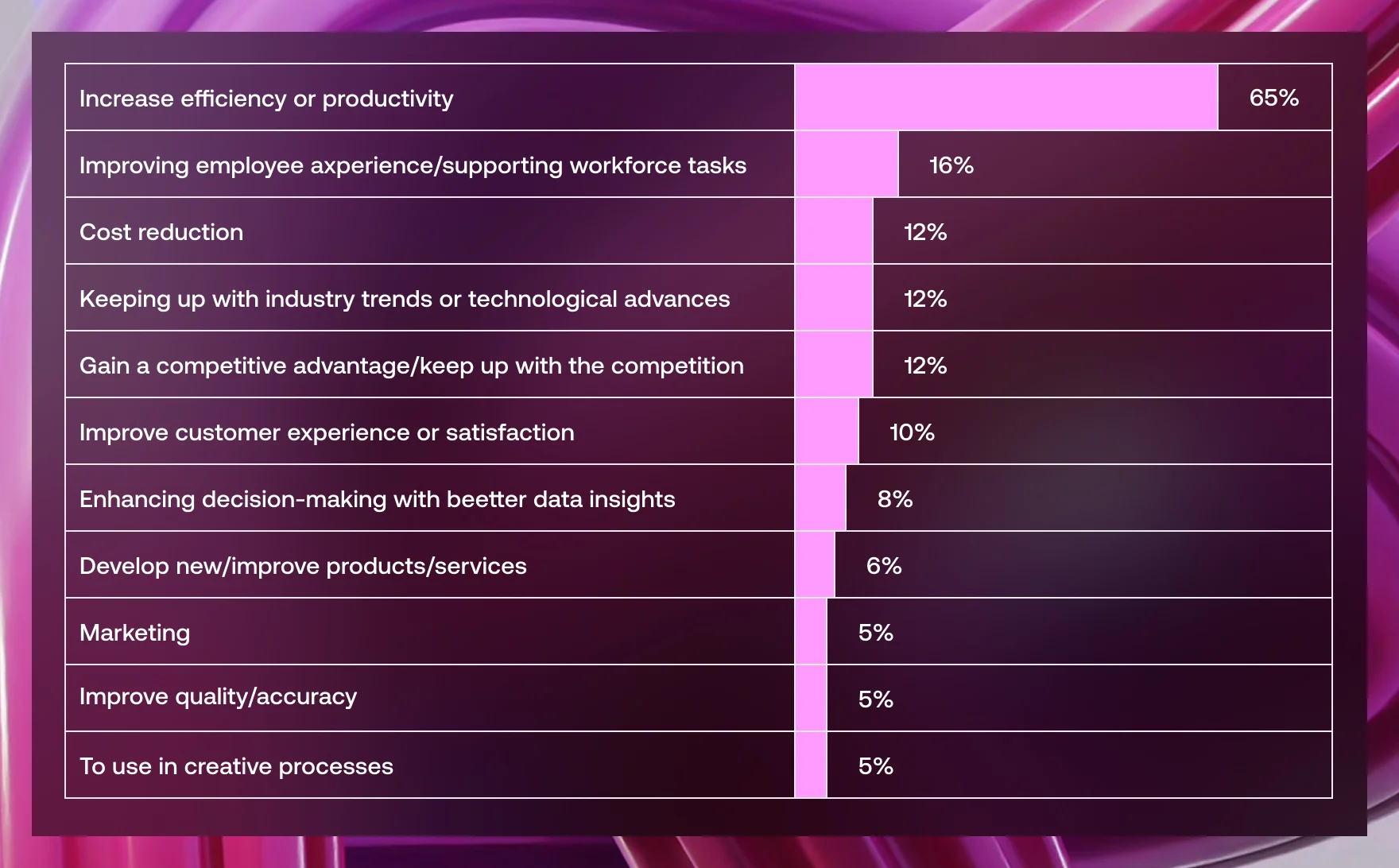
AI usage by UK SMEs and large enterprises: adoption rates and objectives
Adoption rates vary significantly by company size: 36% of large businesses and 23% of mid-sized businesses currently use AI, compared with just 14% of micro businesses.
When looking at purpose, improving internal operations remains the main motivation for adopting AI across all business sizes.
Purposes for AI usage among different business sizes
Develop a new product or service | Explore a new market | Improve business operations | Provide or personalise products or services to customers | |
|---|---|---|---|---|
Micro businesses (up to 10 employees) | 22.1% | 15.1% | 49.1% | 28.9% |
10-49 | 14.5% | 8.3% | 53% | 20% |
50-99 | 17.4% | 9.5% | 59.8% | 21.3% |
100-249 | 14.3% | 7.1% | 59.1% | 19.2% |
250+ | 13.3% | 7.4% | 58% | 18.1% |

For SMEs, improving business operations is not the only objective:
- 54% use AI to automate tasks
- 45% apply AI for marketing and advertising
- 31% use AI for customer service
- 19% deploy AI to support decision-making
Large enterprises, by contrast, focus more heavily on data-driven applications:
- 86% use AI for data analytics
- 75% use AI for automation
- 79% use AI for administration and support
Do AI adoption and usage of AI technologies differ across UK regions?
There is little difference between UK regions in terms of AI adoption, with gaps of only a few percentage points. London, as the centre of business and innovation, nevertheless leads in AI implementation among businesses.
AI technologies used by businesses across UK regions, December 2025
Data processing with ML | Image processing with ML | Robotics | Text generation with LLMs | Visual content creation | Business doesn’t currently use AI techs | |
|---|---|---|---|---|---|---|
Northern Ireland | 12.7% | 5.7% | 5.7% | 12.2% | 14.8% | 49.8% |
Scotland | 16.9% | 6.9% | 3.8% | 16.9% | 10.9% | 47.5% |
Wales | 16.5% | 6.2% | 4.1% | 14.3% | 13.2% | 44% |
England | 15.7% | 7.2% | 3% | 18.1% | 13.1% | 49.4% |
South West | 16.7% | 7.2% | 4.1% | 18.3% | 12.5% | 45.9% |
South East | 17.5% | 7.6% | 3.3% | 18.6% | 12.6% | 45% |
London | 23.2% | 9.7% | 2.3% | 25.7% | 16.6% | 36.8% |
East of England | 18.5% | 7.9% | 3.6% | 17.8% | 12.9% | 45.7% |
West Midlands | 15.8% | 6% | 4.6% | 17.5% | 12.7% | 46.5% |
East Midlands | 15.6% | 7.1% | 4.1% | 14.3% | 12.4% | 46% |
Yorkshire and the Humber | 16.5% | 7.5% | 3.3% | 15.6% | 13.4% | 47.6% |
North West | 17.4% | 7.6% | 3.9% | 17.9% | 13.7% | 44.5% |
North East | 19% | 7.6% | 4.3% | 16.3% | 13.3% | 45.5% |
UK total | 15% | 6.9% | 3.1% | 17.6% | 12.8% | 50.5% |
What types of AI are adopted more often in the UK?
Natural language processing (NLP) and text generation are the most popular AI types adopted by UK organisations.
Top AI types used among technology adopters in the UK
Agentic AI
Hardware related to AI
Other
Machine learning
Computer vision/image processing and generation
Natural language processing and text geeration
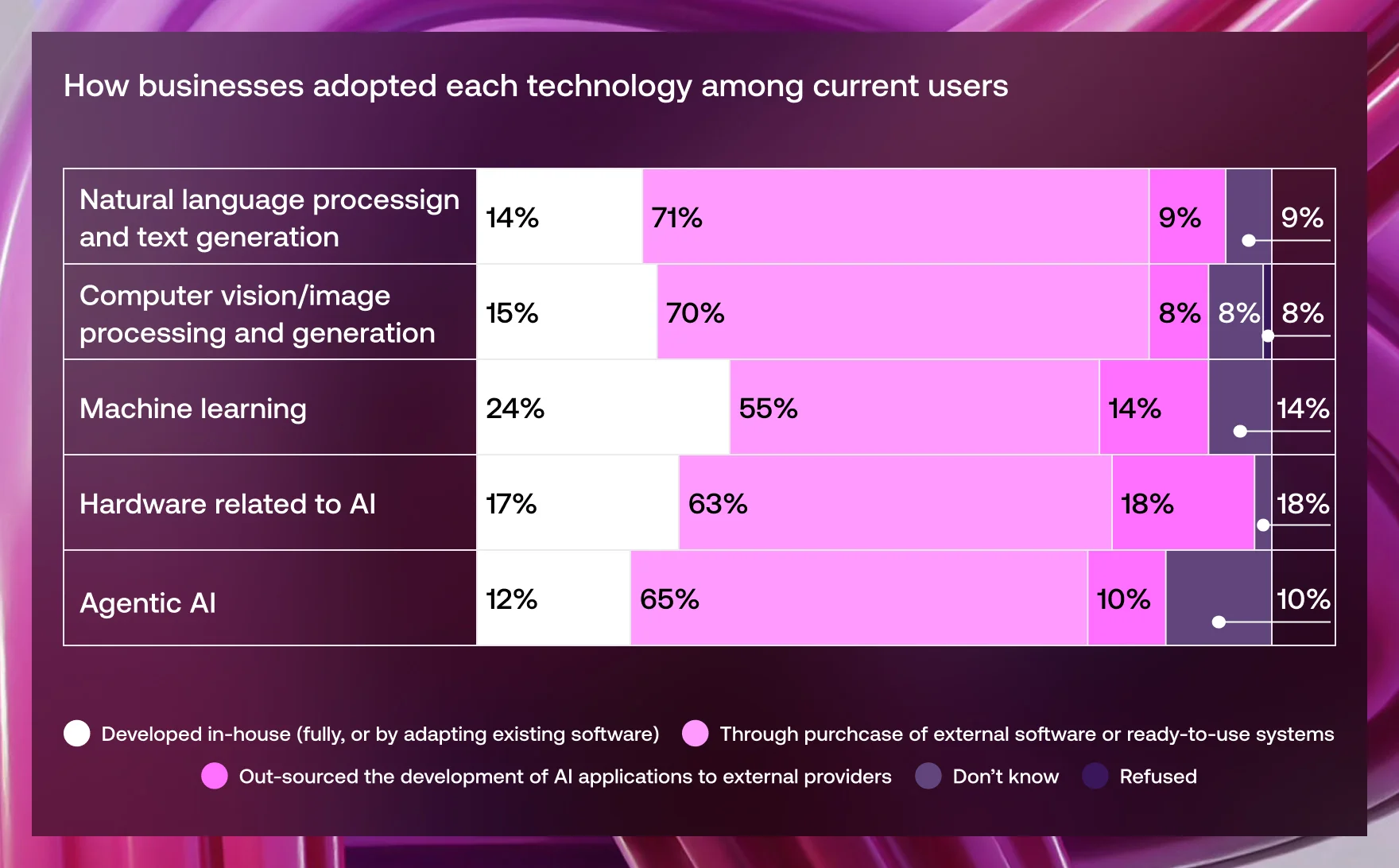
How businesses adopted each technology among current users
The majority of businesses that already leverage AI tools adopted them through purchasing external or ready-to-use systems.
Artificial intelligence adoption in the UK: trends and predictions
By 2030, generative AI could contribute more than £400B to the UK economy and increase annual labour productivity growth by 1.5 percentage points. AI is expected to reshape how value is created across sectors, from financial services and healthcare to manufacturing and the public sector.
As of late December 2025, approximately one in seven UK businesses (15%) report plans to adopt AI technologies within the next three months. Computer vision and image-based technologies appear to be near-term priorities among the UK companies, while more autonomous “agentic AI” systems generate greater hesitation.
Planned timeframe for UK businesses to adopt AI technologies
Within a year | Within 2 years | Over 2 years | Don’t know | |
|---|---|---|---|---|
NLP and text generation | 48% | 24% | 19% | 7% |
Computer vision, image processing, and generation | 52% | 22% | 18% | 6% |
Machine learning | 20% | 42% | 24% | 10% |
Agentic AI | 24% | 27% | 24% | 10% |
The UK approach to AI regulation in a nutshell
Public demand for AI oversight is strong while awareness of existing regulation remains limited.
of the UK public believe AI regulation is required
of the UK public are aware of AI regulations and policies in their country
believe that current AI regulatory safeguards are sufficient
of the UK public disagree that the government will regulate AI responsibly
UK regulatory bodies that govern AI adoption
Public confidence may be mixed, but the UK has taken a deliberate approach to AI governance that aims to balance innovation with accountability. The country doesn’t have a single AI Act or a central AI regulator overseeing adoption across all industries. Instead, the UK follows a sector-led approach: the government sets common AI regulatory principles, and existing regulators apply them using their current legal powers.
- The Information Commissioner’s Office oversees AI compliance with data protection laws.
- Ofcom regulates AI in online services, broadcasting, and telecommunications.
- The Competition and Markets Authority (CMA) investigates the impact of AI foundation models on competition and consumer protection.
- The Financial Conduct Authority (FCA) monitors AI use in financial services for safety, fairness, and accountability.
- The Medicines and Healthcare products Regulatory Agency (MHRA) regulates AI as a medical device.
- AI Security Institute conducts research and safety testing on AI models.
Does the spread of AI affect jobs in the UK?
So far, there is limited evidence that AI adoption is reducing headcount across UK businesses. Only 4.1% of all UK businesses report reducing headcount following AI adoption, while just over half report no change. The data suggests that, at least for now, AI is used primarily to augment productivity rather than replace roles.
The impact of AI technologies on workforce headcount
Increased headcount | No change | Reduced headcount | |
|---|---|---|---|
0-9 | 1.3% | 51.7% | 3.7% |
10-49 | - | 56.1% | 7.3% |
50-99 | 2.4% | 60.1% | 6.5% |
100-249 | 2.4% | 53.8% | 7.7% |
250+ | 1.7% | 48.2% | 5.8% |
All size bands excluding 0 - 9 | 1.1% | 56.3% | 7.2% |
All businesses | 1.3% | 52.4% | 4.1% |
Public expectations: will AI change jobs?
More than a third of the UK public believe AI is unlikely to change their jobs significantly in the near future.
UK public poll on AI and jobs: How likely is AI to change your current job in the next five years?
Very likely
20%
Somewhat likely
31%
Not likely
39%
Concerns around AI adoption among UK organisations
In September 2025, UK businesses were asked whether any of the following factors had prevented or delayed AI adoption. The results were largely reassuring: more than half of businesses that attempted to implement AI tools reported no barriers. However, a lack of AI expertise remained the most common reason for delaying AI adoption.
Uncertainty about government regulations or industry standards
2.2%
Security concerns
3.5%
Product or service availability
1.4%
Level of expertise in artificial intelligence
8.2%
Difficulty identifying business use cases
6%
Employee concerns about any potential impact of using AI
2.7%
Cost
6.3%
Business reported no barriers or delays
54.1%
Business has not attempted to use AI technologies
22%
Not sure
8.7%
Regulatory risks affecting AI adoption
While general regulatory uncertainty ranks relatively low as a barrier to AI adoption, specific legal risks are more prominent, particularly those related to data protection and intellectual property.
Regulatory concerns that have prevented or delayed UK businesses from adopting AI
Cost of compliance with regulations
Difficulty of compliance with regulations
Exposure to copyright-related legal risk
Exposure to intellectual property-related legal risk
Exposure to data protection-related risk
Exposure to legal risk of using AI technologies in the business’s own sector
A note from Vention
The data tells a genuinely encouraging story about UK AI ambition. Strong investment, sector-leading adoption, and a regulatory direction that's more pragmatic than most of Europe.
The next step for many organisations is moving from active experimentation to deep integration: embedding AI into the workflows where it will have measurable, lasting impact. That's where a structured engineering approach makes the difference.
At Vention, we work with UK clients to design AI around their real business processes, navigate the evolving regulatory landscape, and build the internal capability to operate these systems with confidence."

CTO of Digital Solutions at Vention, UK

Ready to explore how AI can accelerate your business?
AI adoption is no longer a question of ‘if’, but ‘how’. Whether you’re looking to improve operational efficiency, strengthen data capabilities, or deploy AI responsibly, we can help you move from experimentation to tangible impact with clear ROI.
Speak with our London-based experts to assess your opportunities, define a practical roadmap, and implement AI in a controlled and effective way.
+44 207 117 2842
Churchill Place
London E14 5RE, UK
contact@ventionteams.com
Sources:
List of sources
Grand View Research, Business.gov.uk, Global AI Ecosystem, Digital Catapult, Dealroom.co, ONS, Department for Science, Innovation and Technology (DSIT), KPMG, Ipsos Global Trends, Eurostat, U.S. Census Bureau, YouGov, Goldman Sachs, Google, Information Commissioner’s Office, Ofcom, GOV.UK, FCA, AI Security Institute