



Global adoption, local strategy: How markets break one-size-fits-all AI
480+ leaders reveal where AI is creating advantage and where it’s stalling
AI has moved from innovation labs to executive agendas. In the boardrooms of startups and enterprises alike, the conversation has shifted from "Should we explore AI?" to "How fast can we make it drive results?"
But here’s the catch: while adoption is rising everywhere, the path forward looks radically different depending on where you operate.
Some markets are treating AI as a competitive advantage. Others prioritize governance, workforce readiness, and operational control. The gap between low-stakes experimentation and enterprise-wide impact now goes beyond technology alone. It comes down to leadership decisions.
Based on insights from 480+ senior decision-makers, this report examines how companies across the US, UK, and DACH* regions are approaching AI in 2026. It highlights where they are investing, what is slowing progress, and what separates momentum from hesitation.
If AI is now a leadership priority, the real advantage lies in how deliberately you act.
*Germany, Austria, Switzerland, and Liechtenstein
One technology. Three executive mindsets.
Leaders share a similar ambition across regions. What differs is how fast they move, where they apply AI, and what they expect from partners.
At a high level, regional AI maturity now clusters into three distinct executive mindsets:
- US: AI as a growth engine and competitive tool
- UK: AI as a capability to be governed, learned, and scaled responsibly
- DACH: AI as an efficiency lever defined by stability and control
In practice, the US sets the pace, the UK follows with measured momentum, and DACH advances more deliberately. It’s a familiar cultural pattern: speed and scale in the US, pragmatic governance in the UK, followed by cautiousness and risk discipline across DACH.
For leaders, recognizing these differences is essential. These geographical profiles serve as the north star for how AI is perceived, whether for benchmarking, risk posture, or investment pace relative to global peers.
From interest to implementation
How each region views AI directly shapes how leaders implement it.
US: AI moves to the center of corporate strategy
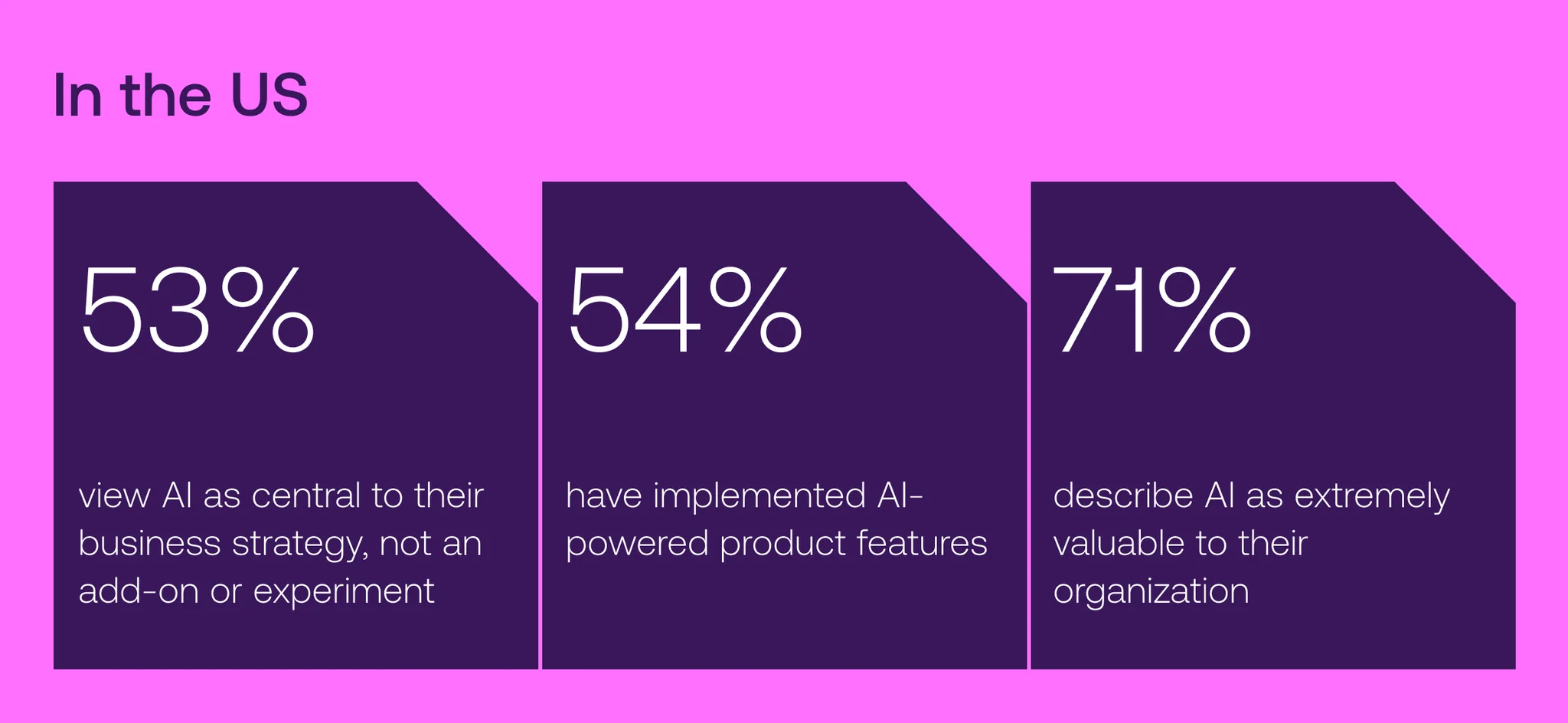
US companies lead in both confidence and execution:
- 53% view AI as central to their business strategy, not an add-on or experiment
- 54% have implemented AI-powered product features
- 71% describe AI as extremely valuable to their organization
For US leaders, AI is fundamentally about speed, differentiation, and ROI. The conversation quickly moves from if to how fast.
In the US, tech leaders speak in outcomes: metrics, acceleration, competitive advantage.
UK: Measured progress through AI enablement
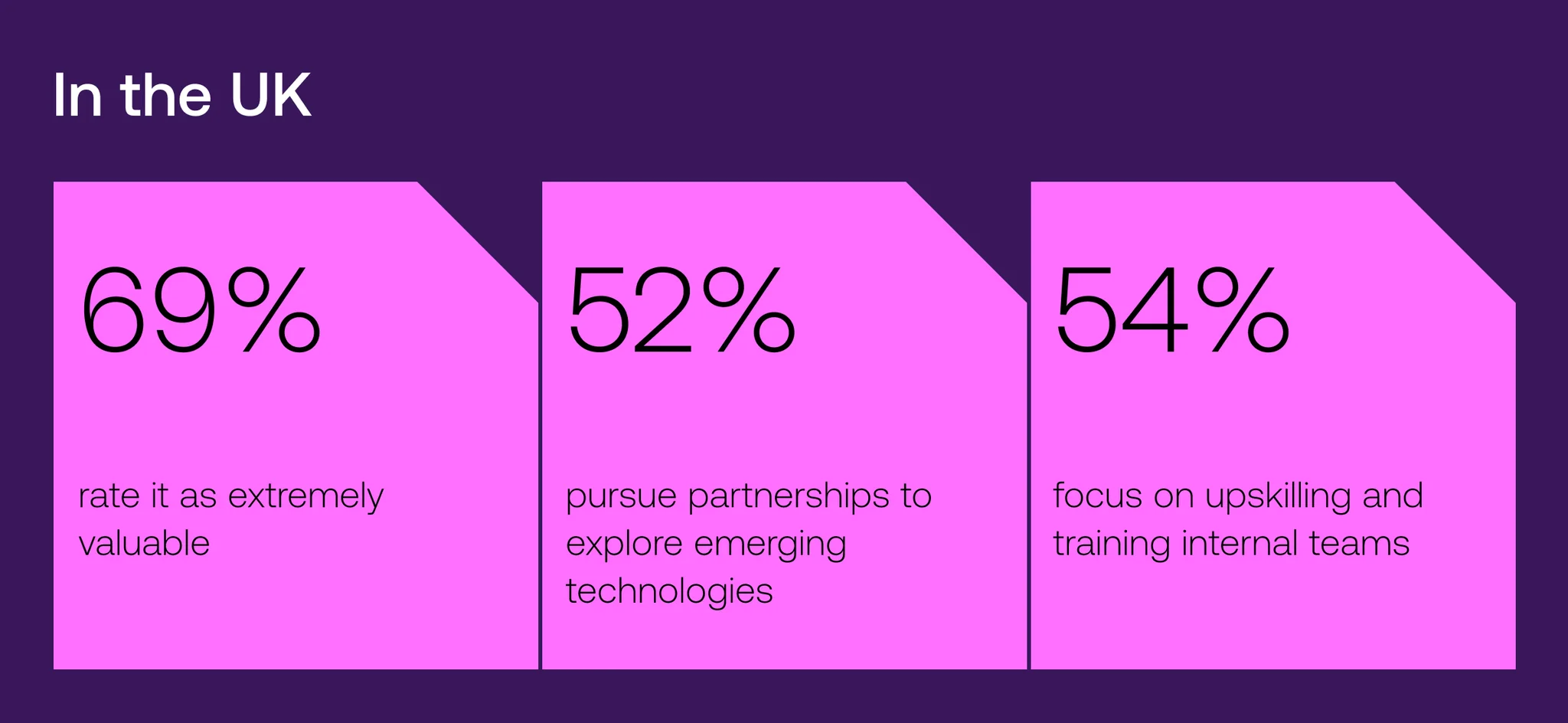
UK leaders strongly believe in AI’s value but apply it more selectively:
- 69% rate it as extremely valuable
- 52% pursue partnerships to explore emerging technologies
- 54% focus on upskilling and training internal teams
In the UK, leaders often scope AI around specific use cases rather than making it the backbone of product strategy. They emphasize governance, collaboration, and long-term readiness.
In the UK, education, transparency, and risk mitigation carry as much weight as technical delivery.
DACH: Controlled AI adoption with internal ROI focus
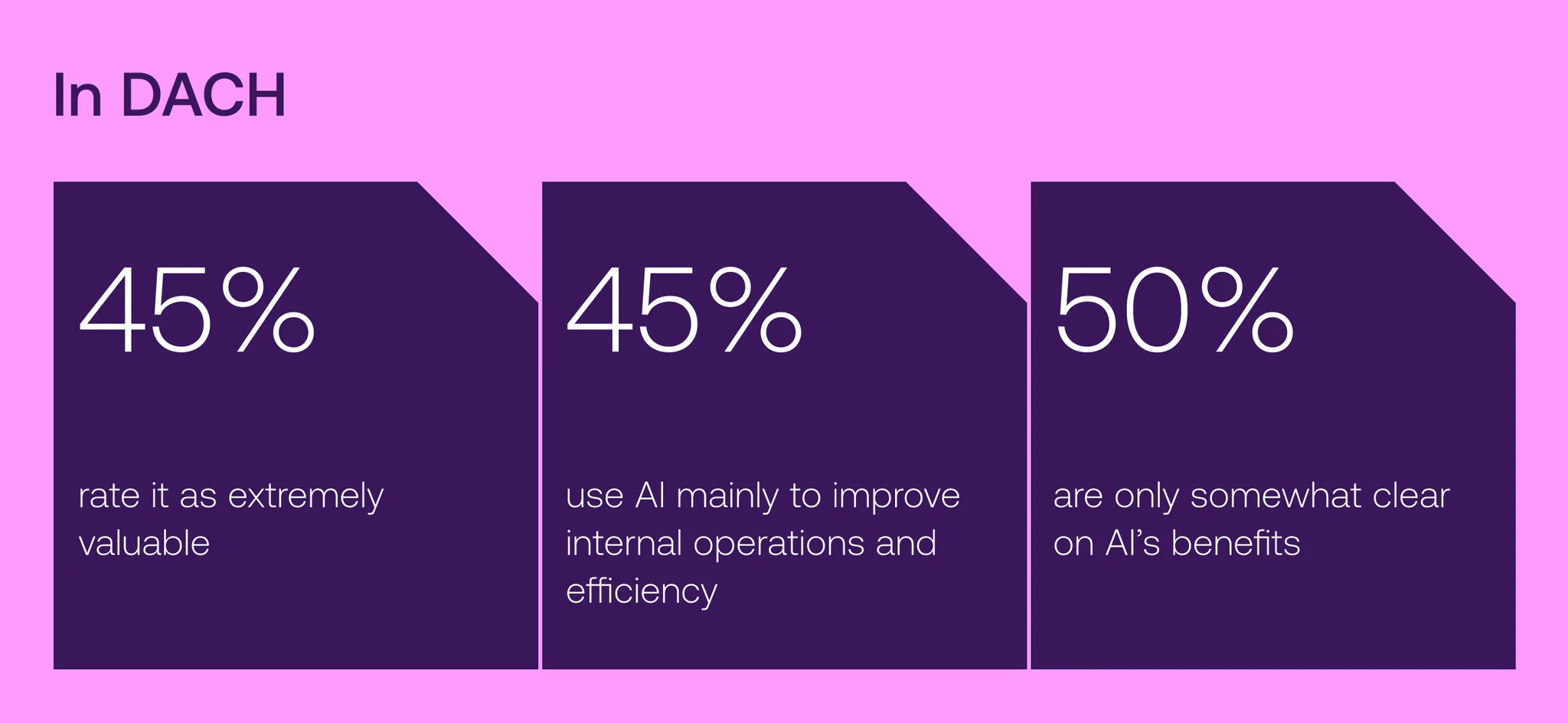
DACH organizations take the most cautious approach, where AI is primarily seen as a tool for internal optimization rather than market-facing innovation:
- Only 45% rate it as extremely valuable
- 45% use AI mainly to improve internal operations and efficiency
- 50% are only somewhat clear on AI’s benefits
This skepticism does not reflect disinterest. Instead, it reflects a strong preference for reliability, compliance, and proven value.
In DACH, AI earns trust through precision, stability, and tangible efficiency gains.
Leaders know what to expect from AI
Expectations for AI’s role in software development vary by region:
- US leaders prioritize faster code generation and accelerated delivery.
- UK and DACH leaders place greater emphasis on cybersecurity enhancements and risk reduction.
A simple pattern emerges: Speed excites American teams. Safety reassures European ones.
Workforce impact: optimism vs. skepticism
Beliefs about AI’s impact on developer headcount reveal another regional divide:
- 45% of US leaders strongly agree that AI will reduce developer headcount
- UK and DACH leaders show more skepticism, with 33% actively disagreeing
Across Europe, leaders more often position AI as an augmentation tool rather than a replacement.
Leaders are actively seeking AI partners
What companies look for in AI partners reflects both maturity and mindset:
- US: AI strategy creation (42%) leads, followed by custom AI/ML development (32%)
- UK: Risk management (32%) and AI training for teams (32%) dominate
- DACH: Custom AI/ML development (34%) and expert consulting (29%) take priority
These priorities align closely with how each region defines value, risk, and long-term impact.
What speeds AI up, and what quietly kills momentum
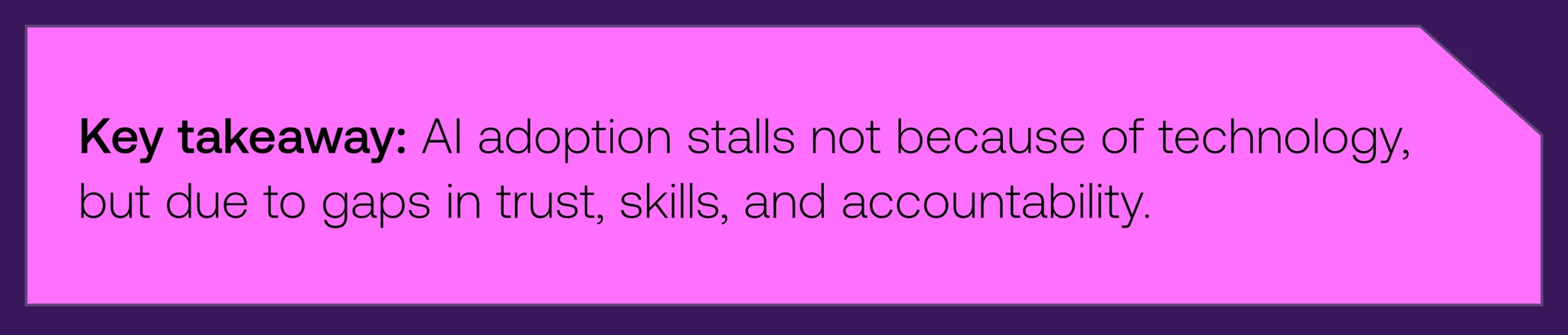
AI initiatives rarely fail because the technology isn’t powerful enough. They stall when confidence breaks down.
Behind every delayed rollout or paused investment sits a leadership calculation: Is this secure? Is it compliant? Do we have the right talent? Can we trust the output?
The companies that understand and address these critical friction points head-on can move faster and with fewer, often costly, course corrections.
What’s holding leaders back
Despite enthusiasm, certain concerns also emerge more frequently according to the region:
- US: A heavily cited blocker is the lack of internal AI talent (31%)
- UK: Ethical and legal concerns are the top barrier (36%)
- DACH: Code quality and security worries dominate (40%)
Trust signals that actually work
Reassurance looks different across markets:
- US leaders perceive official AI partnerships as the strongest indicator of credibility
- UK leaders want partners that employ certified AI experts and quality guarantees
- DACH leaders also value partners with certifications and official platform partnerships, but reject overly aggressive “pioneer” messaging

Choosing AI partners in a high-stakes environment
One thing is clear. Businesses expect more than raw capability from an AI partner, and alignment with regional expectations now shapes the final decision.
US: The strategist
US leaders want partners who can help them move fast and think big.
- What they search for: AI strategy creation (42%), expert AI/ML development (32%)
- Top priority: Quality of engineering and code (20%)
- Strongest trust signals: Official AI platform partnerships (49%), AI case studies (40%)
UK: The educator
In the UK, AI partners are expected to teach as much as they build.
- What they search for: AI training (32%), risk management (32%)
- Top priorities: Efficient delivery (17%) and technical expertise (16%)
- Strongest trust signals: Certified AI experts (48%), official platform partnerships (47%)
DACH: The expert
DACH leaders prioritize depth, reliability, and long-term alignment.
- What they search for: Expert AI/ML development (34%), AI expert consulting (29%)
- Top priority: Long-term strategic partnership (15%)
- Strongest trust signals: Certified AI experts (44%), peace-of-mind guarantees (39%)
The AI advantage will belong to decisive leaders
The next phase of AI adoption will reward businesses that look beyond the technology. Real advantage comes from understanding the people, priorities, and pressures behind every buying decision.
Leadership takeaways:
US
- Bridge the talent gap: Despite higher maturity levels, 31% of US leaders cite a lack of internal AI talent as a primary blocker. Seek partners who bring hands-on, execution-level expertise, not just high-level strategy.
- Focus on applied innovation: Prioritize vendors who can demonstrate AI-augmented software development in practice rather than just theoretical roadmaps.
UK
- Prioritize governance: Ethical and legal concerns remain the top barrier. Invest in AI workshops and programs that center on risk management, compliance, and accountability.
- Demand reassurance: Choose partners with certified AI expertise and clear, tangible quality guarantees.
DACH
- Human-in-the-loop: DACH leaders prefer AI solutions that include human QA and oversight to maintain the quality and security standards they expect.
- De-risk investments: Use paid workshops to validate use cases and prove ROI before committing to large-scale deployments.
The broader truth: AI success no longer depends on adopting tools faster than competitors. Long-term advantage comes from aligning AI initiatives with organizational readiness, regulatory exposure, and risk appetite.
No single AI strategy fits every market. Leadership teams must define their ambition clearly, align it with their risk posture, and move forward with conviction.
AI isn’t a trend. It’s a leadership decision.
We partner with business leaders worldwide to define and execute AI strategies aligned with real business KPIs. Whether you are implementing, refactoring, or building from scratch, our teams bring strategic clarity, engineering depth, and hands-on execution.
We embed AI across the software lifecycle. Our engineers apply it throughout design, development, testing, and release, with human oversight at every critical stage. Quality, security, and accountability stay central from the first line of code through production.
AI may look different across regions. Your peace of mind should be constant.
Leaders want confidence that their partner understands local expectations and delivers with precision, speed, and the right level of governance. That is the standard we hold ourselves to on every engagement.


