


Kafene: A cloud-native fintech platform for point-of-sale financing
Vention helped design and build Kafene’s fintech platform from scratch on AWS, implementing a production-grade architecture with isolated EKS clusters, Amazon Aurora in private subnets, and layered protection using AWS WAF and Cloudflare.
Key achievements include a reduction in partner integration time from one to two months to one to two weeks. A seven-person Vention team now delivers work previously handled by 14 engineers.
Client overview
Kafene is a fintech startup focused on making flexible ownership of everyday retail goods possible. Through its lease-to-own (LTO) platform, Kafene enables retailers to offer accessible financing to customers across all credit profiles, including those with limited or no credit history.
The platform relies on real-time underwriting, payments, and compliance workflows. As the product scaled, security, availability, and scalability on AWS became critical areas to get right.

Key stats
Partnership duration
3+ years, ongoing
Team growth
3.5x (from 2 to 7 engineers)
Partner integration time
Reduced from 1-2 months to 1-2 weeks
Engineering efficiency
Increased by 15-20%
The challenge
As Kafene scaled rapidly, its AWS-based platform needed to support continuous feature releases without compromising stability. The previous vendor operated in reactive bug-fixing mode, accumulated technical debt, and struggled to maintain consistent delivery quality.
Kafene was looking for a partner who could:
- Stabilize and evolve the AWS-based fintech platform
- Support real-time underwriting and payments at scale
- Replace fragile implementations with reliable, production-grade infrastructure
- Strengthen operational, security, and deployment practices
- Expand engineering capacity without sacrificing quality or delivery speed
Our solution
We joined Kafene as a long-term engineering partner, with a focus on AWS-native architecture, platform reliability, and delivery maturity.
Scalable AWS architecture
Vention helped design and operate a cloud-native platform built on AWS:
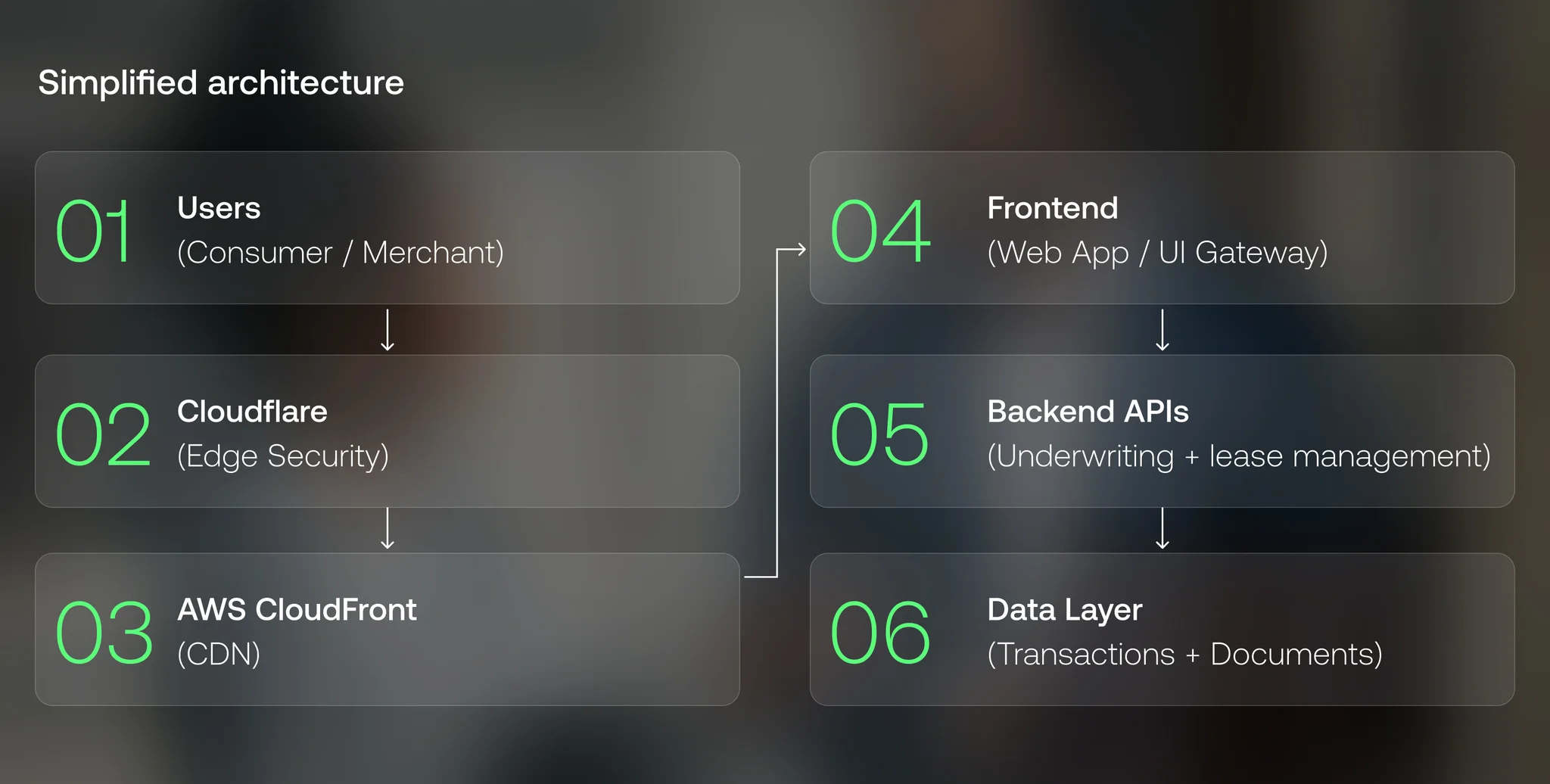
- Frontend hosted on Amazon S3 and CloudFront, protected by Cloudflare DNS and WAF
- Backend microservices running on Amazon EKS, fronted by ALB Ingress and WAF
- Three isolated EKS clusters for UAT, staging, and production to support safe promotion and limit blast radius
- Amazon Aurora deployed in private subnets and accessible only from EKS
The resulting architecture supports high availability, fault tolerance, and secure isolation, all of which are essential for fintech workloads.
Background processing and analytics
To keep non-critical workloads from affecting real-time decision-making, we separated execution models and introduced the following structure:
- AWS Batch for large-scale batch processing
- EKS CronJobs for scheduled tasks such as automated billing
- AWS Lambda for lightweight, event-driven workflows
- Snowflake as the analytics layer, ingesting data from multiple microservices into a centralized data lake, fully decoupled from transactional systems for real-time performance protection
Security and governance on AWS
Security was built into every layer of the platform to protect sensitive data, support compliance, and reduce operational risk. Key measures included:
- End-to-end TLS encryption and encryption at rest
- Least-privilege IAM, private networking, and restricted S3 access
- AWS WAF and Cloudflare WAF for layered perimeter protection
- Skyflow for sensitive data encryption and tokenization
- Centralized identity management through Okta
- CrowdStrike deployed across company laptops
- Secure secrets management using Doppler
Smarter development flow on AWS
To improve delivery speed and code quality, Vention modernized the software development lifecycle:
- Fully automated CI/CD pipelines using GitHub self-hosted runners
- Pull requests, peer reviews, and CodeRabbit AI checks embedded in the workflow
- QA validation required before any production release
- Strict artifact versioning to support safe rollbacks
- Progressive deployment across UAT, staging, and production environments
AI-enabled development
We also introduced AI-assisted development using Cursor IDE to reduce repetitive work and improve code understanding across the team. As a result, overall engineering efficiency increased by an impressive 15-20%.
Results
Kafene now operates on a secure, production‑grade AWS platform, with core systems remaining stable while new features ship on a consistent cadence. The company gained the technical foundation required to scale underwriting, payments, and merchant integrations with confidence.
Key outcomes:
- Reduced platform onboarding time from one to two months to one to two weeks
- Consolidated engineering workload: seven Vention engineers now handle work previously managed by 14 client-side engineers
- Improved code quality: 96% of the codebase aligned with established architecture and style standards
- Accelerated pull request review time by 30% with CodeRabbit AI assistance
- Reduced pre-production security risk, lowering operational and compliance exposure
With a production-grade AWS foundation in place, Kafene is now positioned to expand their financing offerings, grow merchant partnerships, and improve profitability, while maintaining the reliability and security required in fintech.
Kafene’s continued partnership with Vention has helped us establish a best‑in‑class cloud infrastructure. In the 3+ years we have worked with Vention, we have set up infrastructure that not only supports our current month-over-month growth but can also accommodate growth over 10 times what we are currently running.
The ideation that my internal team and Vention have developed to build the most modern, scalable, and secure infrastructure has truly paid off. This infrastructure also allows our developers to continue writing code at lightning speed without having to worry about deployment, CI/CD, or infrastructure constraints.”

James Schuler
Co-Founder of Kafene
Tech stack
FAQs
How did Vention stabilize Kafene’s AWS infrastructure?
Vention designed a cloud-native platform on AWS with three isolated EKS clusters across UAT, staging, and production. The team deployed Amazon Aurora in private subnets and implemented layered protection with AWS WAF and Cloudflare WAF. Automated CI/CD pipelines enabled controlled promotion between environments.
All of that established a production-grade foundation before scaling features and integrations.
How does Kafene handle security and compliance on AWS?
The Kafene platform uses end-to-end TLS encryption, least-privilege IAM policies, private networking, and restricted S3 access. Sensitive data is protected through Skyflow tokenization, identity is centralized via Okta, and perimeter security is enforced with AWS WAF and Cloudflare WAF.
How did Vention improve engineering efficiency and delivery speed?
The team implemented automated CI/CD pipelines, enforced strict artifact versioning, required peer-reviewed pull requests, integrated AI-supported code review, and structured promotion across UAT, staging, and production.
Engineering efficiency increased by 15-20%, while pull request review time decreased by 30%.