



UrgentIQ: Scaling an AI-native urgent care platform
UrgentIQ partnered with Vention to scale the development of its AI-native electronic medical record and practice management platform for urgent care providers.
Working alongside UrgentIQ’s internal team, Vention engineers contributed to three connected products: the core clinic application, the Patient Portal, and the Patient-Led Intake. The engagement covered frontend and backend development, quality engineering, healthcare integrations, payments, patient-facing workflows, and AI-assisted clinical functionality.
The joint team developed product features that use OpenAI and other specialized AI services to reduce manual clinical and administrative work. These include visit documentation, patient history summaries, treatment plan drafting, semantic search, and diagnosis code recommendations.
Vention engineers also used Claude Code as part of the software development process. The team created 10 Claude Code Skills across backend and frontend repositories to support implementation, testing, migrations, feature flags, permissions, observability, and other recurring engineering workflows.
Client
Project description
Our solution
Scaling the core urgent care platform
Vention engineers worked as an extension of UrgentIQ’s internal product team, contributing to both existing applications and new functionality.
The team helped refactor and stabilize the platform while expanding workflows used by medical providers, front-office staff, patients, and billing teams.
Vention contributed to features including:
- Patient scheduling and queue management
- Digital pre-registration and check-in
- Patient records and visit documentation
- SMS appointment and payment notifications
- Role-based access and feature permissions
- Insurance information capture and verification
- Electronic prescribing
- Laboratory and radiology integrations
- Healthcare data exchange
- Document and medical result management
The engineering team also supported integrations with a lot of third-party services, including DoseSpot, HealthGorilla, and Stedi.
Patient Portal and Patient-Led Intake
Vention helped expand UrgentIQ beyond its core clinic application by contributing to the Patient Portal and Patient-Led Intake.
Patient Portal allows patients to manage appointments, communicate with clinics, and access documents and medical results through a clinic-specific environment.
Patient-Led Intake provides a streamlined patient onboarding experience before an in-person visit. Patients can select an available appointment slot, enter personal and insurance information, upload supporting documents, and complete pre-registration steps online.
Once submitted, the appointment and patient information become available to clinic staff, reducing the amount of data that must be collected manually when the patient arrives.
Vention engineers also supported optical character recognition functionality for identification and insurance documents. The system extracts relevant information from uploaded documents and uses it to populate patient records.
Payments and insurance workflows
Vention contributed to payment functionality across UrgentIQ’s platform, supporting card, cash, and check payments as well as terminal-based card transactions.
The team also helped implement workflows to capture and verify insurance data. Patients can provide insurance information during pre-registration, while clinic staff can verify coverage through integrated services.
These capabilities connect patient intake with the platform’s wider billing and practice management workflows.
AI-assisted visit documentation
Vention contributed to an AI-assisted workflow that records conversations between healthcare providers and patients and converts them into structured clinical documentation.
A specialized transcription service processes the audio, while OpenAI-based functionality supports semantic search and interprets relevant medical information. The workflow helps identify and structure details such as symptoms, procedures, diagnoses, and prescriptions.
Semantic search helps the system match medical concepts even when clinicians use synonyms, abbreviations, or alternative spellings. This is particularly important for medications and clinical terminology that may be expressed differently during a consultation.
The resulting information can be added to the patient's chart, reducing manual data entry. Healthcare professionals review the generated content before it becomes part of the clinical record.
AI-assisted summaries and treatment plans
Vention also contributed functionality to generate concise summaries of a patient’s recent visits.
The system can summarize information from the five most recent visits, helping clinicians and authorized administrative staff understand the patient’s recent history without reviewing each chart separately.
Additional functionality uses OpenAI models to draft treatment plans based on the context supplied to the system. These outputs support clinical documentation and remain subject to review by the healthcare professional.
Diagnosis-code recommendations and model evaluation
Vention engineers helped develop and refine UrgentIQ’s diagnosis-code recommendation functionality, which analyzes symptoms, procedures, and other information recorded during a visit to suggest relevant codes to clinicians.
The feature is designed to support accurate code selection and charge capture rather than make medical decisions. The clinician remains responsible for reviewing the recommendations and approving the final diagnosis and code.
To determine which approach produced more accurate medical coding recommendations, Vention engineers tested two implementation strategies. The first involved fine-tuning a model on historical visit examples. The second relied on detailed prompt engineering, providing the model with coding principles and relevant information from the patient visit.
Vention also contributed to a model-switching capability that allowed the team to evaluate different providers within the same workflow. Engineers tested OpenAI and Anthropic models, compared the quality of their recommendations, and adjusted the configuration in response to performance and customer feedback. The team found that, with current-generation models, recommendation quality depended more on providing strong contextual information and carefully structured prompts than on adapting the underlying model to historical examples.
This flexible architecture enables UrgentIQ to select models based on recommendation quality instead of becoming permanently dependent on a single provider. Vention continues to support the evaluation and refinement of the feature as models and product requirements evolve.
AI-enabled software delivery with Claude Code
Vention engineers used Claude Code to support implementation, pull-request review, test creation, documentation, debugging, and release preparation.
To make these workflows more consistent and project-specific, the team created 10 Claude Code Skills across the backend and frontend repositories.
Backend Skills supported tasks such as:
- Taking a feature from context gathering and planning through implementation, unit tests, and integration tests
- Creating commit-ready integration tests
- Assisting with the database migration flow
- Adding feature flags
- Introducing AI vector embedding types for semantic search support
- Creating workers that generate and store reference-data embeddings
- Instrumenting AI features with OpenInference tracing
Frontend Skills supported: Generating and updating typed API hooks Adding permission keys, access variants, runtime gates, and related tests Updating tests to reflect changed application behavior The frontend repositories also included AI-assisted scripts for test coverage analysis, code review, and release note generation.
Claude Code supported recurring engineering work, while Vention engineers remained responsible for reviewing generated code, validating implementation decisions, and confirming that changes met the project’s requirements.
Security-conscious healthcare engineering
UrgentIQ’s platform processes sensitive healthcare and patient information, making security and access control essential to the engagement.
Vention engineers primarily worked in test environments, while access to production data was restricted. Patient information was removed or blurred in screenshots shared for development and issue investigation.
UrgentIQ also regularly commissions independent penetration testing of the platform.
Key metric | Details |
|---|---|
8+ additional patient visits per day | with UrgentIQ’s streamlined workflows |
10 Claude Code Skills | supporting engineering workflows |
3 connected UrgentIQ products | supported by Vention |
Results
FAQs
How does UrgentIQ help clinicians serve more patients?
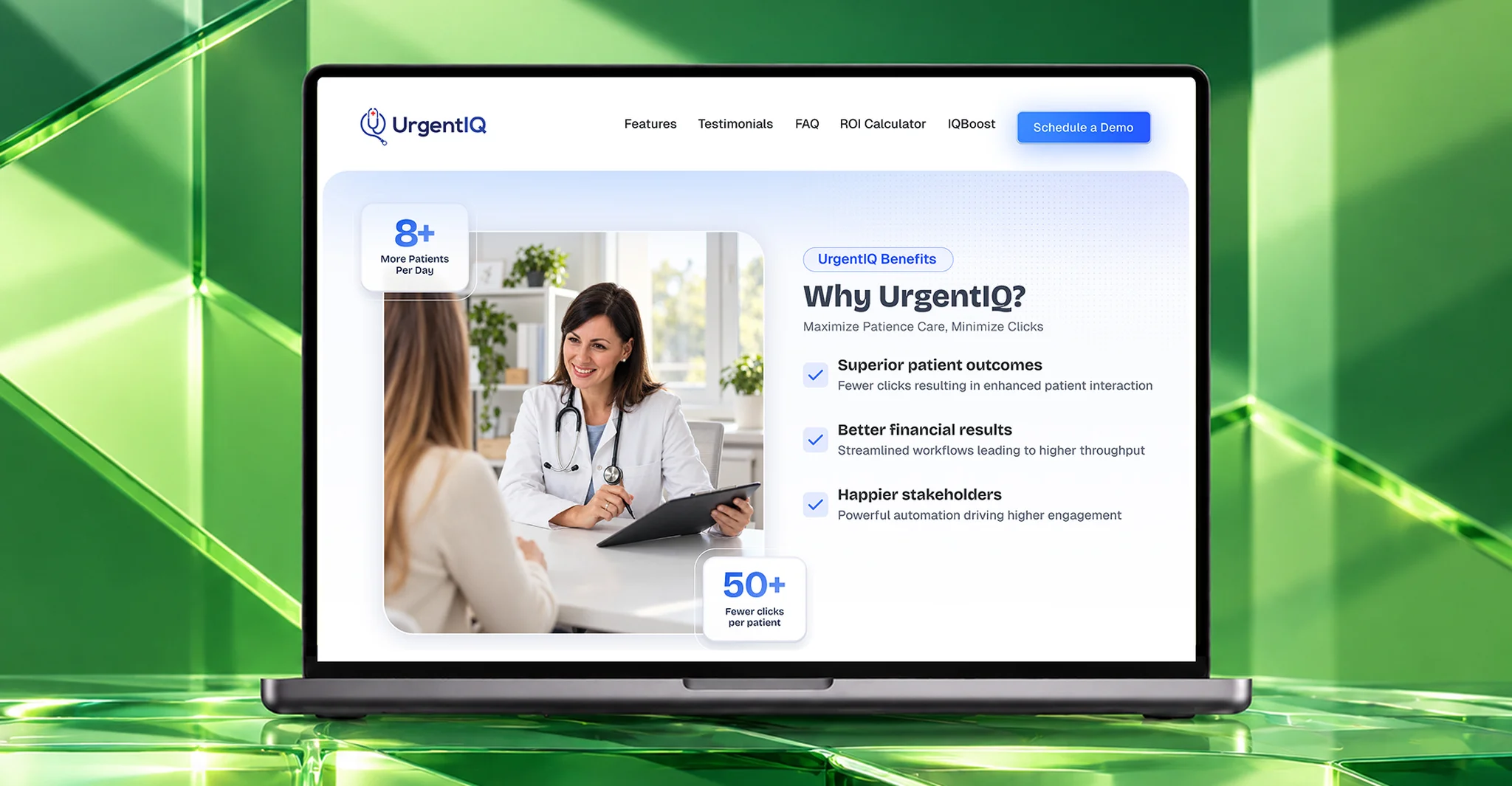
UrgentIQ reports that its streamlined workflows can help urgent care teams see more than eight additional patients per day while eliminating over 50 clicks per patient.
Vention contributed to the clinical and administrative workflows for this experience, including digital intake, visit documentation, patient history summaries, diagnosis code recommendations, insurance verification, and integrations. Together, these capabilities reduce repetitive tasks and give clinicians more time to focus on patient care.
How did AI support software delivery on the UrgentIQ project?
Vention engineers used Claude Code to support implementation, testing, pull-request review, debugging, documentation, and release preparation.
The team also created 10 project-specific Claude Code Skills for recurring backend and frontend workflows, including feature implementation, integration testing, database migrations, feature flags, API hooks, permissions, and AI observability. Engineers reviewed and validated all AI-generated work before it entered the product.
How does UrgentIQ protect sensitive patient data?
UrgentIQ presents its platform as HIPAA- and EPCS-compliant and uses encryption, access controls, regular security audits, and data backups to protect healthcare information.
During the development, Vention engineers worked in test environments, without production data access. Patient information was removed or blurred in screenshots used for issue investigation.