



Cybersecurity: Balancing velocity and vulnerability in AI delivery
How 480+ technology leaders are navigating the tension between speed-to-market and security in an era of accelerating AI adoption
While AI has moved fast, cybersecurity has struggled to keep pace.
As organizations across the US, UK, and DACH region push to embed artificial intelligence into their products, pipelines, and engineering practices, a familiar tension has emerged: the pressure to ship quickly is colliding with the discipline required to ship safely.
The result is a security gap that technology leaders can no longer afford to ignore.
In Vention’s first two white papers, we examined how regional mindsets shape AI adoption and how organizations use AI workshops to bridge the gap between strategy and execution. This third report turns to the question that cuts across both: what does it take to build AI fast without building it dangerously?
Based on insights from 480+ senior decision-makers across the US, UK, and DACH region, this report examines the security barriers slowing AI adoption, the governance frameworks that high-performing teams are putting in place, and why the leaders who treat cybersecurity as a foundation (not an afterthought) are the ones gaining a durable competitive advantage.
*DACH refers to Germany, Austria, Switzerland, and Liechtenstein
The new security mandate
For technology leaders, the appeal of AI in software development is clear. Faster code generation, quicker delivery cycles, and less manual work make a strong, well-documented case for productivity.
But productivity without protection becomes a liability.
When we asked leaders across three markets what is holding their organizations back from deeper AI adoption in development, one answer stood out above all others.
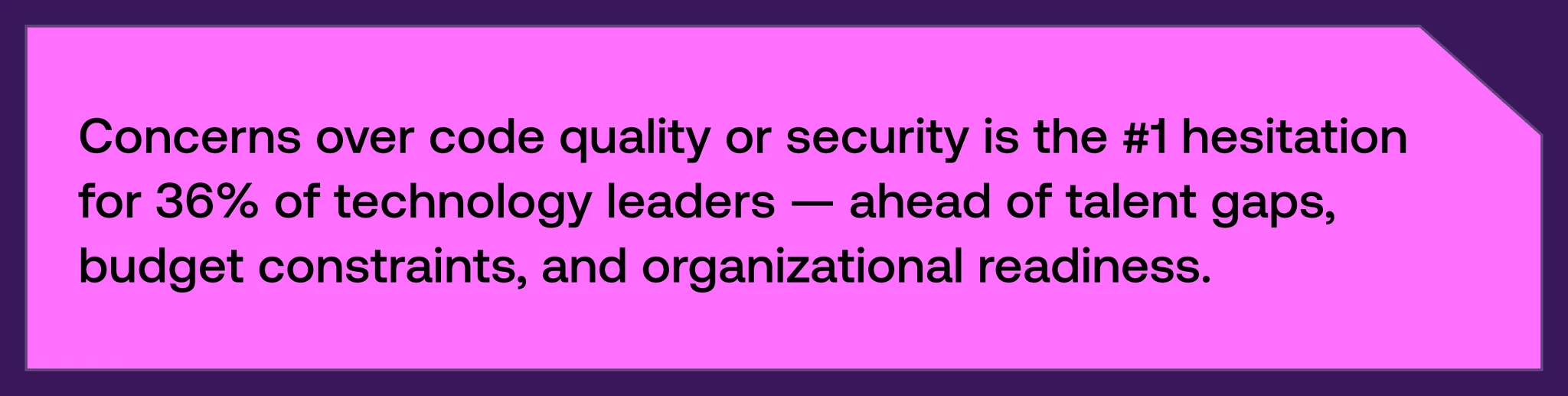
This is not a fringe concern. It is the main blocker. And it becomes even more acute in markets where regulatory scrutiny, enterprise governance expectations, and client data obligations create a high-stakes environment for every technology decision.
What makes this finding important is not just its scale, but its precision. Leaders are not expressing vague discomfort with AI. They are pointing to a specific risk: AI-generated code, AI-integrated tooling, and AI-assisted development pipelines introduce new paths for vulnerability. The controls designed for human-authored software may not be enough to manage them.
The security mandate for AI is not simply an extension of existing cybersecurity practices. It is a new discipline. Organizations that recognize this early are better positioned to move fast without putting the integrity of what they build at risk.
Velocity vs. vulnerability: A shifting balance
The relationship between speed and security in AI development is not static. It is evolving, and the data shows a clear shift in how technology leaders prioritize these competing demands.
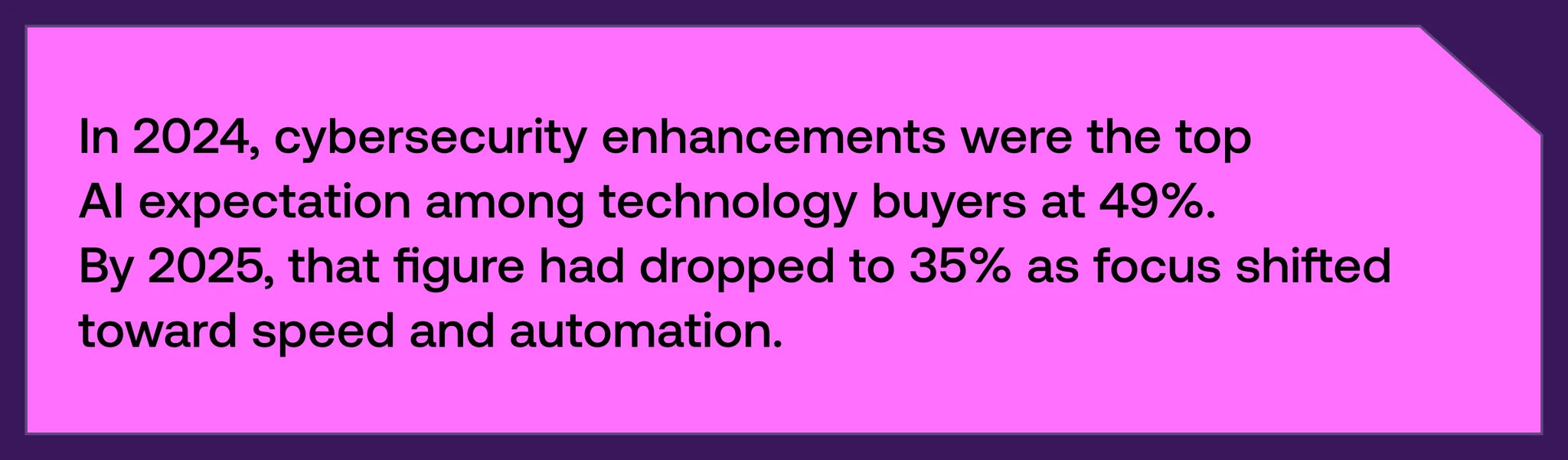
On the surface, this might read as a retreat from security consciousness. In practice, it reflects something more nuanced. As AI tooling matures and early adopters gain experience, the conversation is shifting from whether AI can be secure to how to make it secure at scale.
Organizations that moved first are no longer asking whether to adopt AI. They are asking how to govern it. When done well, governance enables speed rather than constraining it. Leaders falling behind are still treating security and velocity as opposing forces.
Leaders gaining ground understand that a strong security foundation is not a brake on AI delivery. It is what makes sustainable AI delivery possible.
The regional dimension
This tension plays out differently depending on where an organization operates, and understanding the regional dimension is essential for any leader building or evaluating AI capabilities across markets.
- US buyers prioritize speed: 46% of US technology leaders identify faster delivery and code generation as their primary AI expectation. Security remains important, but it is rarely the headline priority. American teams are optimizing for momentum.
- UK and DACH buyers prioritize protection: Both European markets consistently rank cybersecurity enhancements significantly higher than their US counterparts. For UK leaders, ethical and legal risk frames every AI decision. For DACH organizations, code quality and security concerns represent the single largest barrier to AI adoption at 40%.
This divergence goes beyond cultural risk appetite. It reflects real differences in regulatory exposure, client expectations, and the professional consequences of a security failure in each market. For vendors and technology partners operating across these regions, a one-size-fits-all security posture is not sufficient.
Governance frameworks: From checkbox to competitive advantage
When security is treated as a compliance exercise, it creates friction without adding value. When it is treated as a governance framework embedded into the engineering process, it becomes a differentiator.
The most effective AI security postures we observe share a common architecture: they are systematic, verifiable, and built into the development lifecycle rather than applied at the end of it.
What rigorous AI governance looks like in practice
- ISO-certified processes: Implementing internationally recognized quality and security standards gives AI development a verifiable foundation. It also signals credibility to enterprise clients, regulated industries, and European buyers who expect documented assurance.
- Mandatory cybersecurity sign-offs: All AI tooling, integrations, and generated code should pass defined security review criteria before integration into a production environment. This is not a one-time audit. It is a recurring gate built into every sprint, every release, and every deployment.
- AI code audits: Regular, structured reviews of AI-generated code, assessed against the same quality and security standards as human-written code, are becoming standard among high-performing teams. These audits protect intellectual property, surface vulnerabilities, and create an evidence trail that meets both internal governance and client requirements.
- Rejected tool lists: Not every AI tool that promises productivity gains is safe to use. Keeping a documented list of evaluated and rejected tools, along with the rationale, builds discipline, reduces shadow AI adoption, and provides a clear record for clients and auditors.
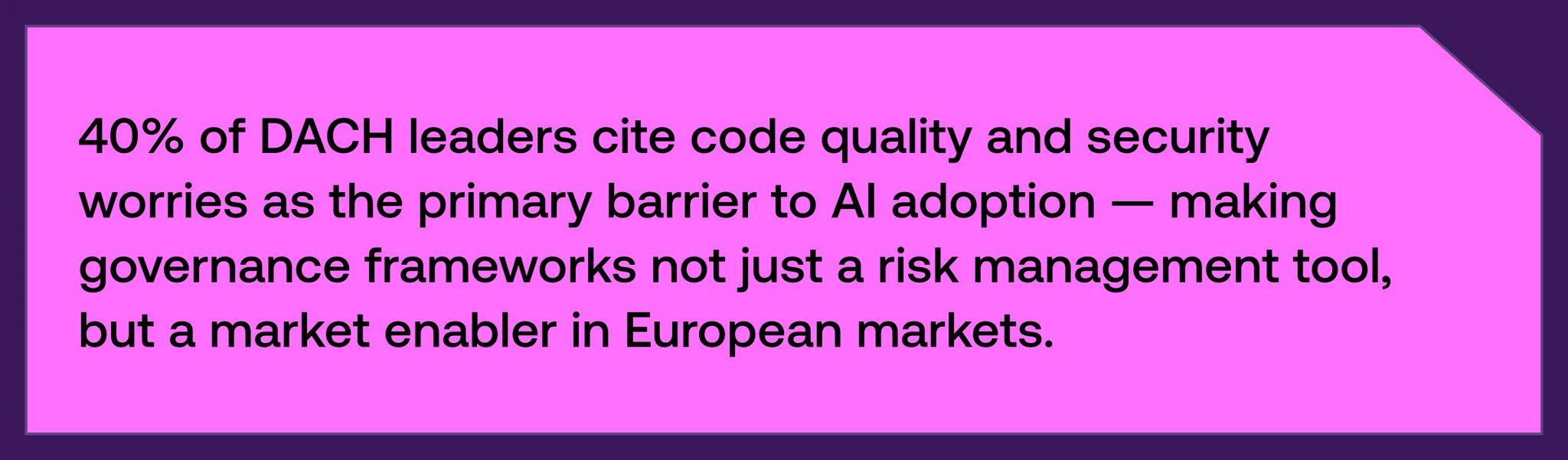
For technology leaders evaluating partners, the presence of a formal AI governance framework is increasingly a procurement filter. In markets where regulatory scrutiny is high and client expectations are exacting, the absence of documented governance is a disqualifying signal.
The Peace of Mind strategy: Accountability as a product feature
Governance frameworks establish the rules. Culture determines whether those rules are followed.
Organizations building the most resilient AI delivery practices are not just implementing policies. They are creating cultures of accountability where security is a shared responsibility across engineering, product, and leadership teams.
A shift in mindset brings practical implications for how AI work is structured, reviewed, and delivered.
100% bug-free guarantees
The most credible signal a technology partner can offer is not a promise of speed. It is a commitment to quality that supports every delivery. In practice, that means defining clear acceptance criteria for AI-generated code, setting up structured review processes to verify those criteria, and standing behind the output with contractual accountability.
For enterprise clients, especially those in regulated industries or dealing with complex IP considerations, a quality guarantee is not a marketing claim. It functions as a risk transfer mechanism. In markets where security hesitation is the main barrier to adoption, it becomes a meaningful differentiator.
Protecting intellectual property
AI-generated code introduces a specific and often overlooked IP risk: training data that includes copyrighted material can surface in generated output, exposing clients to legal liability they may not even realize exists.
Addressing that risk requires explicit policy, not passive hope. High-performing AI delivery teams maintain clear ethical use policies that define which tools can be used, under what conditions, and with what safeguards. Teams review, update, and enforce these policies on an ongoing basis, rather than letting them sit unused.
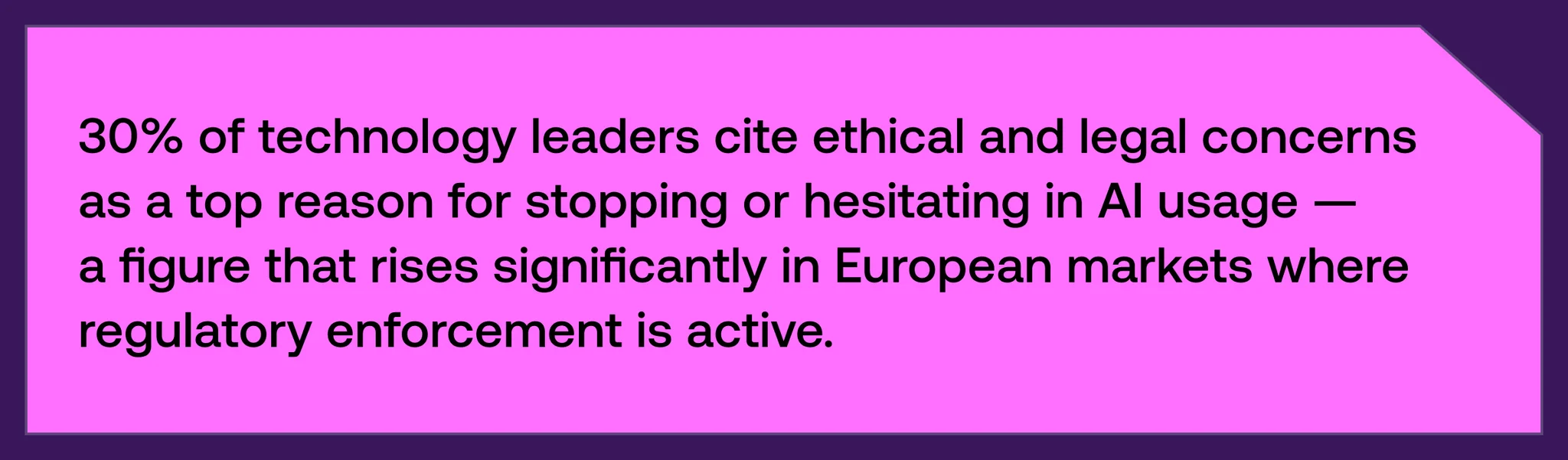
Organizations that treat IP protection as a core part of their AI delivery model, not a legal footnote, are the ones that earn the trust of enterprise clients. That is especially true in the UK and DACH markets, where this concern carries real commercial weight.
Ethical AI implementation: The emerging compliance layer
Beyond code quality and IP protection, a broader ethical dimension is reshaping how technology leaders evaluate AI adoption and what they expect from their partners.
Ethical AI implementation is no longer a values statement. It is becoming a compliance requirement, a procurement criterion, and in some jurisdictions, a legal obligation.
What ethical AI implementation requires
- Clear rejected tool lists: Organizations need documented policies that specify which AI tools are prohibited, including those due to data privacy concerns, IP risk, security vulnerabilities, or noncompliance with ethical use standards. Teams must actively maintain these lists as the AI tooling landscape evolves.
- Ethical use policies: Written guidelines define how AI can be used in development, covering data handling, model selection, output review, and disclosure requirements. Clear policies help prevent well-intentioned engineers from creating compliance risk.
- Copyright code prevention: Specific controls detect and prevent copyrighted code from entering production environments. Enterprise AI programs rely on both tooling and human oversight, as neither is sufficient on its own.
- Human oversight at critical stages: The most effective AI delivery models include human review at stages where decisions carry meaningful quality, security, or legal impact. Automation speeds up delivery. Human judgment protects it.
The regional compliance dimension
Ethical and legal concerns as barriers to AI adoption are distributed unevenly across markets, and this distribution closely reflects the regulatory environment in each region.
UK leaders operate in an environment where AI governance is an active policy priority. Data protection obligations are well established, and enterprise procurement processes increasingly include AI ethics questionnaires. The 36% of UK leaders who cite ethical and legal concerns as a top barrier are not being overly cautious. They are responding to a real and present compliance landscape.
DACH organizations face similar dynamics, reinforced by a cultural preference for precision, verification, and documented accountability. In this market, ethical AI implementation is not a soft differentiator. It is a baseline expectation.
Regional priorities: What each market needs to move forward
The data tells a clear story. Security and ethics are not uniform concerns. They are shaped by market context, regulatory environment, and leadership culture. Effective AI delivery depends on understanding these differences and addressing them directly.
United States: Speed with guardrails
US technology leaders are primarily focused on velocity. With 46% prioritizing faster delivery as their top AI expectation, the conversation centers on how quickly AI can accelerate output.
At the same time, 31% of leaders point to a lack of internal AI talent as a primary blocker, which introduces a related risk. Teams may move fast without the expertise needed to properly evaluate what they are building. In this context, security risk often reflects a capability gap rather than a lack of intent.
What US leaders need are partners who can deliver speed while bringing the security expertise their internal teams lack. The value lies in execution-level capability, not just high-level strategy.
United Kingdom: Governed progress
UK leaders are navigating a more complex environment. With 36% citing ethical and legal concerns as a top barrier and a strong emphasis on upskilling and governance, the UK market demands partners who can teach as much as they build.
Security in the UK context is inseparable from governance. Leaders want to see documented processes, certified expertise, and clear accountability structures, not just reassurance that security is being handled.
What UK leaders need: Partners with certified AI expertise, documented governance frameworks, and a demonstrable track record of delivering within regulatory constraints. Quality guarantees carry specific commercial weight in this market.
DACH: Technical certainty above all
DACH organizations present the most demanding security profile of the three markets. With code quality and security concerns representing the #1 adoption barrier at 40%, and a strong cultural preference for precision over speed, the DACH market requires a fundamentally different engagement posture.
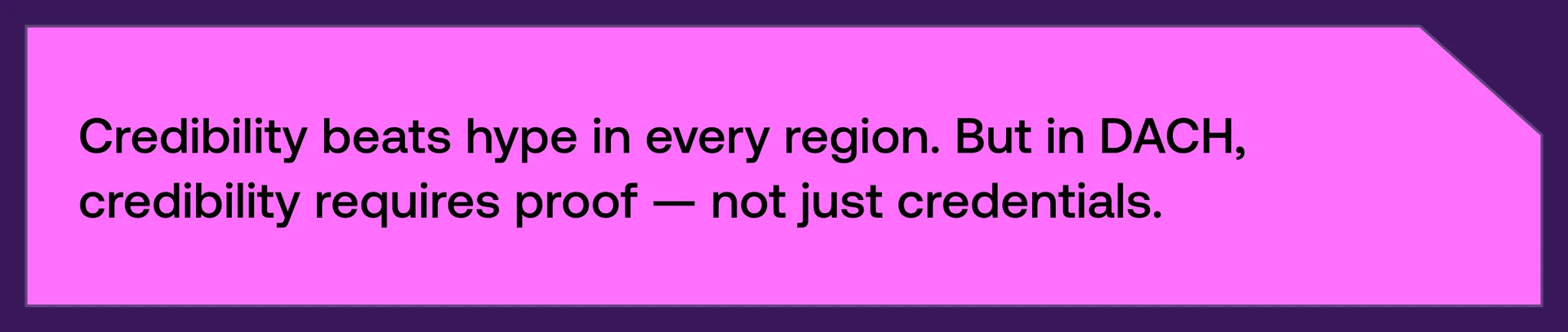
In this context, AI adoption earns trust through demonstration, not assertion. Organizations expect technical proof before committing to scale, including architecture validation, security testing results, and documented audit trails.
What DACH leaders need is clear. Partners who can demonstrate security rigor through verifiable evidence, engage with real technical depth, and support a controlled, phased adoption approach that reduces risk at every stage.
Leadership takeaways: Building AI that is fast, safe, and defensible
The tension between velocity and vulnerability in AI delivery is real, but it is not irresolvable. Organizations gaining the most ground are not choosing between speed and security. They are building systems where each reinforces the other.
For technology leaders evaluating their AI strategy, the following principles represent the emerging standard of practice:
- Treat security as architecture, not audit. Security controls embedded into the AI development lifecycle are more effective and less expensive than controls applied after the fact. Build the governance framework before you need it.
- Make accountability visible. Quality guarantees, bug-free commitments, and documented IP protection policies are not just risk management tools. They are trust-building signals for clients, partners, and regulators. Make them explicit.
- Match your security posture to your market. A US-calibrated approach to AI security will not satisfy a DACH enterprise client. Understand the regulatory and cultural context of every market you operate in — and build partnerships that can navigate those contexts.
- Invest in ethical infrastructure now. The regulatory environment for AI is tightening, particularly in Europe. Organizations that build ethical use policies, rejected tool lists, and IP protection controls today will face significantly less disruption as compliance requirements formalize.
- Choose partners who can prove it. In a market where every vendor claims AI security as a capability, the differentiator is verifiable evidence. Certifications, audit trails, governance documentation, and contractual quality commitments separate credible partners from the noise.
The broader point is simple. AI adoption is no longer just a technology decision. It is a governance decision. Leaders who understand that and build accordingly will strengthen their advantage over the next three to five years without increasing their risk.
Engineering AI Peace of Mind
At Vention, security is not a feature added at the end of delivery. It is built into every stage of the engineering process, from architecture review and tool selection through development, testing, and production deployment.
We maintain ISO-certified quality processes, mandatory cybersecurity sign-offs for all AI tooling, and a rigorous AI code audit practice designed to protect both the integrity of what we build and the intellectual property of the clients we build it for.
Whether the priority is accelerating AI delivery, navigating a complex compliance environment, or building the governance foundation that supports both, Vention teams bring strategic clarity, engineering depth, and documented accountability so you can move forward without second-guessing the outcome.
Don't leave mission-critical up to chance
Leaders want confidence that their partner expertly balances between speed-to-market and security amid accelerating AI adoption. That is the standard we hold ourselves to on every engagement.