


AI readiness assessment
AI initiatives often lose momentum when teams lack time, visibility, or the right tools. Our AI readiness assessment helps you cut through the noise, grounding decisions in real capabilities and business priorities, not assumptions.
Rooted in our approach to engineering peace of mind, it turns your AI maturity level into a clear adoption roadmap, guided by seamless communication, close collaboration, and experts who know the AI landscape inside out and how to bring ROI into focus.
Why an AI readiness assessment matters
Embracing AI is no longer a matter of if but of how soon. For companies aiming to move fast without missteps, success starts with a plan that’s grounded, actionable, and tailored to your real-world context. Our AI readiness assessment is built to offer lasting impact and engineering peace of mind across four critical dimensions:
Strategic alignment
Enterprise AI readiness ensures that innovation efforts tie directly to business outcomes, so growth and efficiency go hand in hand, and every investment supports your competitive edge.
Executive buy-in
An artificial intelligence readiness assessment provides decision-makers with a concrete case for prioritization, helping to streamline approvals and secure board-level support.
Future-proofing
We evaluate both your current capabilities and those required as AI scales across your organization. So, no scaling effort stalls due to overlooked gaps.
Corporate readiness
Our team reviews change management needs and recommends how to facilitate your teams’ adaptation to AI-driven workflows.
What our AI readiness assessment covers
No vague or unviable recommendations. Our assessments are grounded in our deep expertise in AI/ML, cloud, and enterprise integration. They are structured, technically sound, and focused on tangible business outcomes.
Where traditional consultancies stop at high-level strategies and slide decks, we go further. We move straight into proof-of-concept or pilot projects, translating insights into code and app architecture.
Business and use case discovery
The process starts by aligning AI opportunities with your strategic goals. Together, we evaluate where AI can drive measurable value, whether it’s through automation, stronger customer engagement, operational enhancements, or fraud safeguards. From there, we focus on the use cases that balance feasibility with high impact, so your roadmap reflects what’s ready to scale.
For example, a retailer may uncover that automating demand forecasting helps reduce inventory waste, while an insurer may find AI-powered fraud detection delivers stronger ROI than customer-facing chatbots. All these insights shape a strategy that’s measurable, practical, and built for real-world delivery.
What you walk away with:
- A documented list of high-impact AI use cases
- A value vs. feasibility matrix that maps out which AI integration initiatives to prioritize
- A concise report linking each use case to your strategic goals and KPIs
Data and infrastructure audit
We examine your data at the source: how it’s structured, who can access it, and whether governance is in place to support AI adoption. Then we assess your infrastructure (whether it’s in the cloud, on-premises, or hybrid) to identify where your systems stand today and what might limit scalability down the line. By surfacing issues early, we help reduce the friction that typically slows delivery and give you a stronger foundation for progress.
For example, your customer transaction data may be AI-ready, standardized, and stored in a warehouse. However, your marketing data may be scattered across spreadsheets in inconsistent formats, making it unusable for AI models until it is cleaned and integrated.
On the infrastructure side, scalable cloud environments often support GPU workloads out of the box. Legacy on-prem systems, on the other hand, can create performance bottlenecks and introduce tradeoffs that call for hybrid or modernized setups.
What you walk away with:
- A comprehensive evaluation of your data sources, accessibility, and governance
- An infrastructure readiness dashboard that reflects how well your systems support AI workloads
- A gap analysis that outlines risks, inefficiencies, and the upgrades needed to move forward with confidence
Tech landscape and skills
A strong AI strategy depends on both the right tech stack and the people equipped to use it well. We assess your current systems, tools, and integrations to understand how they support AI workloads, while also mapping out your team’s expertise across AI/ML, MLOps, and data engineering. This dual perspective reveals where you’re ready to accelerate and where technical gaps or skill limitations might hinder your progress.
Once your current state is clear, we outline tailored next steps, which may include upskilling internal teams, hiring strategically, or tapping into external engineering support.
What you walk away with:
- A technology capability map comparing your current stack to AI requirements
- A skills inventory showing strengths and gaps across AI/ML, MLOps, and data engineering
- An action plan with practical recommendations for training, hiring, or external support
Risk and compliance
Responsible AI implementation requires robust safeguards that align with your specific regulatory environment. While we don’t serve as formal compliance auditors, our solutions are designed with security and governance built in. We evaluate areas like data protection, access control, and bias mitigation to help ensure your systems operate securely at scale.
With the right measures in place, your AI efforts can integrate more smoothly into existing frameworks and give stakeholders the confidence they need to move forward.
What you walk away with:
- A safeguards checklist covering the technical controls currently in place
- A security risk register that documents vulnerabilities and provides actionable mitigations
AI adoption roadmap
Assessment insights only matter when they lead to action. We translate those insights into a structured roadmap that captures quick wins, identifies high-impact initiatives for broader AI integration, and lays the groundwork for long-term success. The plan reflects your priorities and capacity, so each stage builds toward measurable progress.
Alongside the roadmap, you’ll have clear investment and ROI projections, recommendations for managing AI projects effectively, and a change management plan to help teams adapt smoothly.
What you walk away with:
- A three-, six-, or 12-month roadmap showing phased adoption steps
- An investment and ROI model with projected budgets and returns
- A governance framework outline with structures for oversight, accountability, and change management
Proof of concept planning
We stand behind the results of our assessment and stay by your side as you move into implementation. Once the readiness assessment is complete, we can design a proof of concept that shows AI’s impact in practice. Together, we select a high-value use case, set clear success criteria, and map out the people, technology, and budget needed to deliver results quickly.
What you walk away with:
- PoC blueprint with scope, datasets, success criteria, and evaluation method
- Resource plan, including team roles, technology requirements, and budget allocations
- ROI snapshot modeling the expected business value from the pilot before scaling
Hear from our expert
One of the biggest mistakes in early AI adoption is rushing into pilots without a solid business case. Without alignment to strategy, even strong technology can end up as an expensive experiment. AI discovery workshops and AI readiness assessment shine among our service portfolio, as they have been designed to bring clarity and confidence.”

AI Engineer

Make AI a sure win, not a gamble.
Get a readiness assessment that secures ROI clarity, de-risks adoption, and gives leadership confidence to move forward.
Why Vention
Deep technical expertise
We have 20+ years of experience building custom software across 30+ industries, including fintech, healthcare, retail, automotive, and manufacturing. Our team of 100+ AI specialists has delivered more than 150 AI projects, from proof-of-concept pilots to full-scale custom AI solutions.
That experience translates into fewer roadblocks, faster execution, and a team that already understands your industry, so you can move forward without trial and error.
Tangible ROI delivered through AI
It’s not about what AI could do. It’s about what it’s already doing for companies like yours. Our clients see results that turn heads and shift budgets:
- 90% workload reduction, 30 percent faster client onboarding, and a 65 percent increase in conversions
- Image processing time reduction from weeks to just 15–20 minutes
- Automated claims management for fleets of over 8,000 vehicles
Read all our AI development case studies
Engineering peace of mind and security
We’re ISO 27001–certified, but our real security promise runs deeper than a certificate. From architecture to deployment, we build with reliability in mind: resilient systems, thoughtful governance, and engineering teams that not only ship code but also stand behind it. That’s how we deliver engineering peace of mind, project after project.
Our recognitions
Testimonials
With seamless communication, proven delivery, and real results, we give businesses the peace of mind they need to move forward with AI adoption.

Jeff Frey
Co-Founder at WiseOwl Innovations, LLC
“Vention supported the design and development of the WiseOwl MVP, an AI-powered school library platform. The scope began with a two-week discovery sprint focused on user roles, architecture decisions, and product requirements. Following discovery, their team began sprint-based development to deliver key components.
What impressed me most was that Vention didn’t just act as order takers... they approached the project like true partners. Their team brought thoughtful questions, creative problem-solving, and a clear understanding of our goals.”

Bobby Gilbert
Senior Director of Digital Transformation at Sperry Rail
“My past experience was that third parties just don't get it. But Vention truly challenged our thinking: This PDW [product discovery workshop] was the first time I've seen a complex software project finish under budget and ahead of schedule.”

Hear from our expert
The return on investment from artificial intelligence stems from what it enables: automation that frees teams from repetitive work, personalization that makes customer interactions more meaningful, and analytics that enhance forecasting and reduce risk exposure. Together, these capabilities lead to greater efficiency and the agility to respond faster to change.”
AI Engineer
Assess your AI maturity
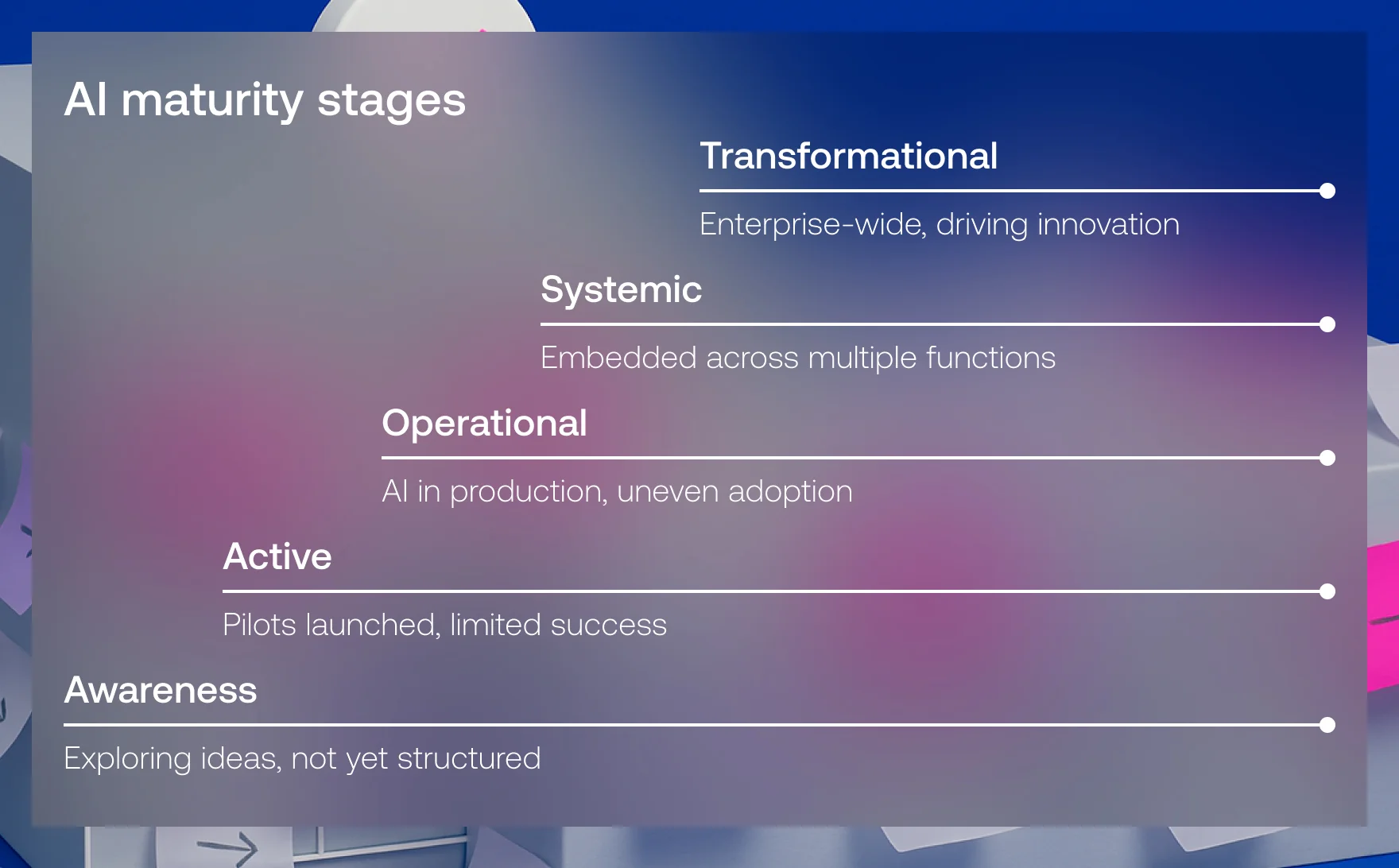
An AI maturity model provides a framework for understanding where your organization stands on the path to AI adoption.
Gartner defines five stages, each showing how deeply AI is embedded into business strategy, culture, and operations.
AI maturity self-check for leaders
If you're unsure how far along your organization really is, start here. This quick AI readiness checklist is designed to help you assess your current maturity across core areas.
For each question, choose the option that best reflects your reality.
- Option 1 = 1 point
- Option 2 = 2 points
- Option 3 = 3 points
- Option 4 = 4 points
Add up your total once you’ve answered everything. The score will give you an initial sense of where your company stands today.
Note: While this tool is a useful orientation exercise, it’s not a substitute for a full-scale assessment. We recommend speaking with one of our business development experts for a more precise consultation tailored to your goals.
Do you have clearly defined AI use cases?
- Not yet
- A few ideas, not formalized
- Yes, prioritized and linked to KPIs
- AI is core to our strategy
How would you rate your data quality and accessibility?
- Fragmented, unreliable
- Usable but inconsistent
- Standardized and governed
- Fully optimized and AI-ready
Are your systems ready to support AI workloads?
- Not yet
- Some readiness, limited capacity
- Ready for operational AI
- Scalable and optimized enterprise-wide
Do you have in-house AI/ML expertise?
- No specialists
- Limited, insufficient expertise
- Growing a dedicated team
- AI embedded across multiple units
Are AI ethics, security, and regulations addressed in your company?
- Not yet
- Some awareness, no formal policy
- Documented policies in place
- Active monitoring and governance
How far have you scaled AI?
- Still at the pilot stage
- Running limited proofs of concept
- Operational in key functions
- Fully scaled across business units
Your AI maturity score
6–11: Awareness
AI is on the radar, but business goals and use cases are still undefined. You’re in exploration mode without structure or prioritization.
Possible next step: Use an AI readiness assessment to focus your efforts, identify real use cases, and align teams around what matters most.
12–17: Active
Early pilots and limited proof-of-concept efforts have started, but success hasn’t scaled beyond isolated teams.
Possible next step: Prioritize high-value opportunities, validate them with PoC efforts, and secure leadership buy-in to move forward with intent.
18–21: Operational
You have established data standards, some skills in place, and are already tracking early ROI. AI is in production, but its implementation is not consistent across the entire enterprise.
Possible next step: Focus on governance, ROI modeling, and developing an adoption roadmap to expand into more business functions.
22–23: Systemic
AI is embedded into multiple functions, with defined policies, monitoring, and measurable outcomes. Scaling is underway, but integration and change management remain key.
Possible next step: Strengthen your roadmap for scale, build cross-functional governance, and plan for enterprise-wide adoption.
24: Transformational
AI is fully integrated into your strategy, driving innovation and competitive advantage.
Possible next step: Keep innovating. There are always more advanced use cases and AI-driven business models to try.
FAQs
How long does the assessment take?
Most assessments take three to six weeks, depending on the complexity of your environment. The process is thorough but efficient: fast enough to maintain momentum, structured enough to deliver tangible insights.
What’s required from our team?
We’ll need input from key stakeholders, as well as access to relevant data sources. Beyond that, we keep the process light on your side. Our approach is built to minimize disruption.
What about compliance?
We’re not compliance auditors, but we do design AI solutions with security and regulatory needs in mind. That can include data protection, access management, and bias mitigation.
Do you support implementation after the assessment?
Absolutely. With our engineering expertise, we can help you move directly from proof of concept to a minimum viable product and eventually to a full-scale rollout.
How does an AI readiness assessment differ from a standard IT audit?
An IT audit typically examines compliance, security, and operational issues. An AI readiness assessment looks ahead: it asks whether your data, infrastructure, skills, and strategy are in place to adopt AI in a way that drives measurable ROI.
What business problems does AI maturity check solve?
It uncovers the friction points that often block AI progress, which could mean disconnected pilots, missing use cases, inconsistent data, or internal uncertainty about where to invest. The assessment helps define what’s worth solving, where the payoff lives, and how to move forward with fewer missteps.
When is the right time for AI readiness assessment?
The ideal moment is when AI has moved beyond buzzword status in your company and become a genuine strategic priority, yet before major investments have been made. Typical triggers include:
- Pressure from leadership or the board to define an AI strategy
- Competitors gaining ground with AI adoption
- Past pilots haven’t scaled or failed to show ROI
- The need to justify AI budgets with a clear ROI model
- Planning for a six- to 12-month digital transformation initiative