


Custom facial recognition software development services
With Vention, you get face recognition software development services backed by deep experience in computer vision and image recognition. We build custom solutions that fully align with your domain-specific needs, integrate flawlessly with existing systems, protect biometric data, and scale effortlessly. All engineered for your peace of mind.

High-impact use cases for face recognition
There’s less than a one-in-a-million chance that a random person could unlock an iPhone protected by Face ID. That’s the power of facial recognition technology on a personal device.
Now imagine applying the same level of reliability across an enterprise in healthcare, manufacturing, fintech, or critical infrastructure. The complexity grows quickly, and we can step in to help manage it. Vention delivers custom facial recognition solutions that cover core and adjacent use cases and are engineered for enterprise-scale integration.
Core facial recognition use cases
Facial recognition for access
Prevent tailgating and ensure only authorized people enter restricted areas and unlock secured devices.
Facial recognition for authorization
Make sure the person is who they say they are and has permission to do sensitive things, like viewing bank account details remotely or approving a payment.
Facial recognition for personalization
Recognize returning customers to tailor services, recommend relevant products, and elevate user experience.
Facial recognition for safety
Enable multi-face detection to identify blacklisted individuals, monitor PPE compliance, or verify correct mask usage.
Facial recognition for administrative procedures
Automate attendance tracking and time logging.
Adjacent facial recognition use cases
Emotion recognition
Recognize faces to analyze user engagement and sentiment or trigger alerts.
Age verification
Verify legitimate access to age-sensitive content or products, at scale.
Facial landmark detection
Power virtual try-on apps and AR experiences with precise mapping of facial features and expressions.
Proctoring
Authenticate test-takers, detect rule violations, and maintain exam integrity with real-time or recorded facial monitoring.
Automated data anonymization
Blur or mask detected faces to protect privacy and support GDPR or HIPAA compliance.
With such a wide range of use cases, the face recognition market is expected to grow at a 16.79% CAGR, reaching $14.55 billion by 2031.
Custom facial recognition software development services
At an early stage and not sure how to move forward? Need a dedicated vendor to take full ownership of your facial recognition platform? Or simply looking for a team to handle the AI component and integrate it with your existing stack?
Vention’s facial recognition software development services flex around your goals. You can start with a proof of concept, scale an existing prototype, or launch a production-ready system with custom models, secure architecture, and real-time performance.
A great option to be confident in your direction.
Explore the possibilities of face recognition software with expert guidance. Vention helps you identify high-ROI use cases, assess feasibility, and define a tailored roadmap.
A great option if you have a skilled in-house development team but need support on the AI side.
Vention trains, fine-tunes, and validates facial recognition models to meet accuracy, performance, and fairness goals. We verify raw data quality, check whether the model performs well with publicly available data, and customize the dataset if needed. You can also involve our team to improve existing models, for example, to cope with model drift or bias.
Custom facial recognition software development
A great option if you prefer to step in only for major decisions during development.
Vention builds face recognition solutions designed around your business workflows and UX requirements. From high-performing deep learning models and custom business logic to seamless integration with your existing systems and delivery on agreed KPIs, we handle it all, so you don’t have to worry about a thing.
Face recognition software enhancement
A great option if you want to stay ahead of evolving business needs, technical standards, and regulatory shifts.
If you already have a facial recognition solution, Vention offers flexible post-launch support, whether you need help scaling across locations, retraining models for better accuracy, extending features, or adapting the system to meet new needs or regulations.
Inside the architecture of a facial recognition system
What your solution will look like depends on your goals, domain, and infrastructure.
There is no one-size-fits-all architecture, and a reference model can help outline the typical building blocks. It reflects what we commonly implement in enterprise-grade systems and can serve as a solid starting point for tailoring to your unique context.
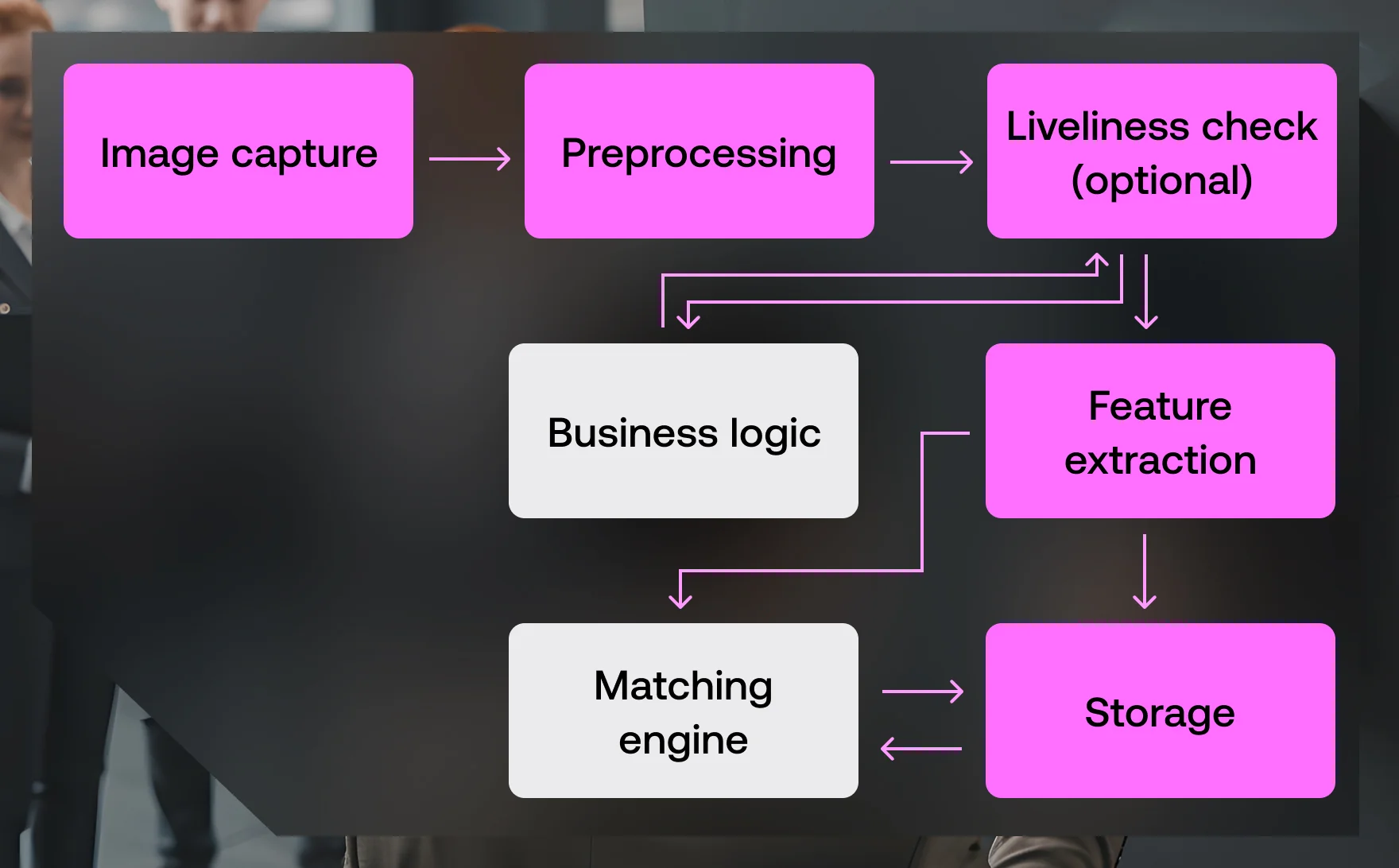
Image capture
Any facial recognition system begins with visual input from cameras. Types can vary based on your environment and performance needs, including:
- Industrial-grade devices
- Laptop or mobile cameras
- CCTV/IP cameras
Preprocessing pipelines
Raw images or video frames undergo a range of preprocessing techniques, each designed to enhance quality and normalize inputs. This may include:
- Contrast and brightness adjustment
- Noise reduction
- Image cropping
- Image rotation
- Occlusion handling
Liveliness check
An optional (but critical) step, especially when working with video input. Dedicated deep learning algorithms help detect whether the system is seeing a real person rather than a static photo, a recorded video, or even a deepfake.
Liveness detection often works in two forms: active and passive. Active checks require a prompted action like a blink or a head turn. Passive checks inspect indirect signs such as light reflections in the eyes or skin texture.
Feature extraction
Perceiving each image as a pixelated canvas, deep learning algorithms recognize patterns among pixels and “see” features like eye distance or forehead height.
Matching engine
A matching engine compares a detected faceprint against a faceprint stored in a database. It can run checks in one-to-one or one-to-many scenarios.
Storage
A face recognition system may store:
- Reference faceprints for identification or verification
- Captured images and metadata (such as timestamps or confidence scores) for audit trails, analytics, or compliance logging
As face data is sensitive, many systems store anonymized faceprints rather than actual photos.
Business logic
Business logic determines how the system responds when a face is or isn’t recognized. Actions could include logging an event, personalizing the UI, or denying access.
Business logic also defines the feedback loop for cases where recognition fails, and the user needs guidance, e.g., “Face not detected, please reposition” or “Please remove the mask.”
Inside facial recognition software
Relying on deep learning algorithms and sophisticated computations, facial recognition is complex under the hood. However, process-wise, it boils down to three core processes: face detection, identification, and verification.
Face detection
The software spots one or more faces in a video stream or image. Modern systems can work with crowded or dynamic environments, recognizing multiple individuals simultaneously, or tracking a detected face across frames. The software can detect faces even when people wear glasses or masks.
Face identification
The system turns a person’s unique facial features into a mathematical representation for further secure processing. This faceprint is then compared against a database of available faceprints to find the match.
For successful identification, the system must support:
- High-quality feature extraction
- Scalable matching algorithms (especially for large databases)
- Tuned thresholds to balance accuracy and speed
Face verification
The system compares the extracted faceprint against a specific enrolled faceprint.
To ensure strong verification performance, systems must include:
- Secure faceprint storage and encryption
- Confidence scoring logic built into the matching engine
How Vention approaches face recognition app development
Facial recognition is quickly becoming the new norm, bringing new opportunities across industries. At the same time, it requires real investment and expertise, which can make the journey feel daunting.
You want strong ROI, high accuracy, and smooth integration with your existing systems. Vention builds reliable software and brings engineering peace of mind through clear decisions, business alignment, and planning that keeps risk under control.
Discovery
Every successful system starts with the right questions. In the discovery phase, Vention works closely with you to define the precise scope of your facial recognition solution:
- Is the system meant to identify a person or verify their identity?
- Will it analyze still images, live videos, or both?
- Does it need to operate in real time?
- Should it detect a single face per frame or track multiple individuals simultaneously?
- What accuracy level and response time are expected?
We also explore your current IT environment and planned integrations. This foundational knowledge will help us:
- Assess technical feasibility
- Identify constraints early
- Prioritize use cases that offer the highest ROI
- Assess possible risks (like occlusions or changing lighting and camera angle, which may negatively impact the software's accuracy)
Design
Vention translates your requirements into an architectural blueprint. As a high-level picture, it covers the components we described in the architecture section:
- Image capture module
- Preprocessing pipelines
- Feature extraction
- Matching engine
- Storage
- Business logic
The blueprint also depicts the key integration points, workflows, and recommended technologies.
Development
Vention assembles the team your facial recognition project needs, including AI experts with specialization in computer vision, front- and backend developers, testers, and DevOps engineers. They translate your idea into seamless code and integrations.
We build the system with scalability in mind, starting with a minimum viable product (MVP) that supports future enhancements.
During face recognition development, we tackle:
- Data quality and preprocessing accuracy
- Model training and tuning, using open-source or custom datasets
- Security hardening, including faceprint anonymization, encrypted storage, and secure APIs
We test every component and make sure the system works well, delivers strong performance, and stays resilient to edge cases such as low light, multiple faces, or spoof attempts.
Support and evolution
Facial recognition systems aren’t static. Deep learning models may need to be retrained as user demographics shift or business logic changes. In many situations, system performance can degrade, which leads to increased false positives and false negatives. Ongoing support helps prevent that.
Every system needs regular tuning and oversight. Vention provides:
- Performance monitoring
- Model retraining
- New features and integrations
- Changes in business logic
Hear from our expert
Depending on the task, the target metric for a face recognition system can look very different.
Some applications can tolerate more false negatives to avoid ever misidentifying someone, while others prioritize a smoother experience for legitimate users and accept a slightly higher false-positive rate. The key is choosing the balance that aligns with the risks and priorities of the real-world application.”

Darya Krauchenia
Senior AI expert
Cost factors
If you’re wondering about the cost of face recognition software, the question is valid and necessary.
Since custom solutions depend on specific objectives, constraints, and deployment environments, costs vary from project to project. At an early stage, a precise estimate isn’t possible, but we can walk you through the key factors that shape development costs.
Factors shaping the development costs
- Project scope and complexity: It’s defined as the number of features, user roles, AI models, and data pipelines that directly influence the development effort. A proof of concept with one user role and use case vastly differs from an enterprise-grade solution.
- Accuracy requirements: Higher accuracy doesn’t come automatically. It takes deliberate effort, from fine-tuning models for poor lighting conditions to building a custom training dataset instead of relying on open-source data.
- Integration needs: The number of integrations facial recognition software requires (e.g., access control systems, HR software, and security infrastructure) and the need to build custom APIs for smooth data flow.
- Data security requirements: The number and level of security measures required. For example, multimodal biometrics is more expensive than face recognition alone. The need to support GDPR, HIPAA, and other legal frameworks also adds to the cost.
- Team composition and seniority level: Highly qualified or rare skills will come with higher rates. At the same time, they will guarantee superior quality compared to junior team members.
Often-overlooked cost drivers
These aren’t part of direct development, but they significantly impact the total cost of ownership and long-term success:
- Hardware costs: Think of cameras, edge devices for real-time on-site processing, and servers (for on-premises deployment).
- Software licenses (in case you use proprietary software, models, or SDKs).
- Cloud costs: a recurring monthly fee in case of cloud deployment.
- Software and hardware maintenance: Typically, maintenance costs account for 20 percent of development costs annually. Depending on the case, you may also need to clean cameras, adjust or replace lighting.
- Data collection, annotation, and anonymization if there’s no ready training data set or insufficient high-quality internal data.
If you'd like to explore further, use our project cost calculator. You can fill it out and get a tailored estimate based on your priorities, timelines, and technical scope. No strings attached.
Facial recognition across industries
With hands-on experience in 30+ industries, Vention teams understand the challenges you face and the opportunities that custom software for face recognition can bring.
Pains you avoid: | |
|---|---|
Healthcare |
|
Banking and financial services |
|
Retail |
|
Education |
|
Interested in knowing more about face recognition in your industry?
Our domain experts are available for a free 30-minute consultation. Let’s discuss how you can disrupt the industry with face recognition software.
Why Vention as your trusted custom facial recognition software development company
Years of experience developing custom solutions
Engineers with AI skill sets
In-house AI center of excellence that continuously handpicks tools, validates emerging tech, and codifies best practices to accelerate reliable AI adoption
AI projects successfully delivered
Satisfied clients across 30+ industries
ISO 27001-certified security management system
Case studies

AI assistant built to enhance efficiency in the operating room
An AI-powered assistant developed by Vention helps prepare operating rooms 23% faster. Leveraging advanced computer vision algorithms, the assistant provides real-time surgical support and monitors overall operating room efficiency.

Image processing automation for Vexcel Imaging
Relying on Vention’s expertise in image processing and drone software development, Vexcel Imaging now takes just 15–20 minutes (instead of weeks) to process 1,000 images. An extra bonus: automated metadata checks help detect and exclude corrupted images.

Trusted by startups and enterprises alike
We deliver secure, high-performance facial recognition platforms for startups, SMBs, and Fortune 500 enterprises.
Testimonials
What matters to us just as much as the software itself is how clients describe working with us. When they say we helped solve real problems, reduced risk, and set them up to scale confidently, we know we’ve delivered on our promise of engineering peace of mind.

Jeff Frey
Co-Founder at WiseOwl Innovations, LLC
“What impressed me most was that Vention didn’t just act as order takers... they approached the project like true partners. Their team brought thoughtful questions, creative problem-solving, and a clear understanding of our goals. They contributed strategic thinking, not just execution, and that made a huge difference in shaping the product.”

Paul Steckler
Founder and Senior Partner at Ramp Catalyst
“Their skill sets helped us secure important cutting-edge industry work. We may be selling a start-up that we built with them. We’re expecting a 10x ROI if the sale goes through, which is significant for the minimal resources we put into it.”

Christopher Vroom
Founder of CollectorIQ, Inc
“The application Vention architected is very robust and complicated, and they’ve done a great job. They’ve enabled us to scale in a very positive way. The fact that we’ve been able to build incrementally on this solid foundation has been a cornerstone of our company’s success.”

Elena Minich
Head of Content at Export Hunter UAB
“The Vention team has been a truly supportive and professional partner throughout our project. They’ve shown a remarkable level of personal engagement with our goals, demonstrating a genuine commitment to our success as a startup.
Communication was always clear, and they kept us fully informed at every step, ensuring we were aligned throughout the process. The management team, in particular, understood the unique challenges we face as a startup, offering innovative solutions while being mindful of our limitations.”

Technologies to power facial recognition solutions
FAQs
Can the system recognize people with masks, hats, or glasses?
Yes, but the AI model should be specifically trained to handle such cases.
How long does it take to develop a custom face recognition solution?
Timelines depend on your project’s complexity. A facial login for an internal HR tool is very different from an airport security identification system.
Developing a proof of concept or a minimum viable product can take up to eight weeks. Large enterprise systems may span 12 months or more.
Can you help us choose the fitting hardware?
kOur primary focus is on custom facial recognition software development services. Still, we'll be happy to assist if you need our recommendation regarding camera or edge device model selection.