


AI Quality Engineering services
Vention helps CTOs and QA leaders establish AI Quality Engineering by bringing development and QA into the same engineering environment. Developers and quality engineers work from the same codebase, repositories, and AI agents, with role-based access. Developer agents generate and modify code, while quality engineers use AI to define quality gates, validate changes, investigate risks, and catch issues before they reach production.
Our AI Quality Engineering approach brings QA into AI-assisted software delivery without compromising software quality or governance. Fewer handoffs between development and QA increase QA capacity without proportional headcount growth and deliver 30%+ faster testing cycles, based on measurements from Vention's internal QA projects.

When to adopt AI Quality Engineering
AI Quality Engineering addresses four common delivery gaps:
- AI transformation gap, when AI adoption is concentrated in development.
- QA transformation gap, when QA is centered on testing.
- Context gap, characterized by reliance on developer handoffs for engineering context.
- Capacity gap, when QA capacity is tied to headcount growth.
Vention brings development and QA into the same engineering environment with quality engineering agents and workflows that work from the same codebase and project context. The table below explains how each gap affects software delivery and how our approach resolves it.
Delivery gap | What you experience | How Vention addresses it |
|---|---|---|
AI transformation gap | AI adoption is concentrated in software development. Code is produced faster, but QA becomes the bottleneck and delivery gains begin to disappear. | Vention sets up and configures quality engineering agents and workflows, extending AI-assisted ways of working across the SDLC rather than concentrating productivity gains in coding. |
QA transformation gap | QA remains focused on downstream testing. Automation speeds up testing, but quality activities such as risk analysis and code-level validation still happen too late. | Vention transforms QA into quality engineering by introducing AI into risk analysis, code-level validation, and continuous feedback throughout the SDLC. |
Context gap | QA relies on developer handoffs to understand implementation details. Context moves through tickets, documentation, and explanations, which creates clarification loops and increases the risk of losing important information. | Vention creates an agentic environment that connects development and quality engineering. Quality agents work with the relevant project context and role-appropriate permissions, reducing the need for developers to package and transfer context before QA engineers can act. |
Capacity gap | QA capacity grows primarily through headcount rather than greater engineer autonomy and AI-assisted workflows. | Vention introduces agent-assisted quality engineering workflows to automate test design, analysis, and failure investigation and expand the scope each engineer can cover. |
Hear from our expert
An AI Quality Engineering environment alone won’t change how your team works. Successful adoption also requires the skills to use and evolve it.
As part of the rollout, Vention assesses your team’s existing QA capabilities, identifies skill gaps, and provides hands-on training so your engineers can operate the new environment independently.”

Siarhei Seniuk
AI Quality Engineering Practice Lead at Vention
How does Vention help establish AI Quality Engineering?
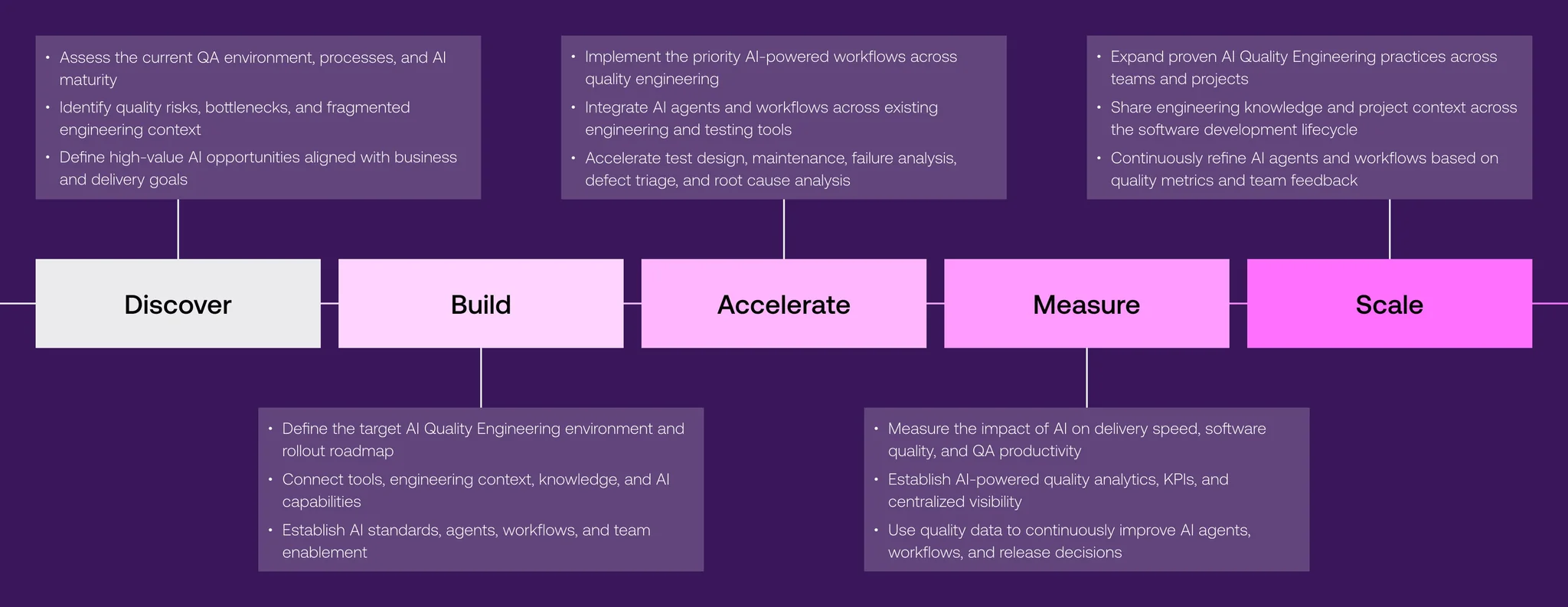
Vention establishes AI Quality Engineering through five stages: discover, build, accelerate, measure, and scale. We assess your current QA environment, processes, and AI maturity, design an AI Quality Engineering roadmap, implement AI-assisted workflows, measure business impact, and scale proven practices across teams and projects.
Stage 1. Discover
Duration: approximately 2 weeks
Our AI-First QA Lead explores how development and QA work today, where context is lost, what slows QA down, and where AI can improve quality and delivery.
Area | What we assess | Potential gaps we are looking to uncover |
|---|---|---|
Team and process | QA team structure, roles and ownership, failure analysis, release decisions | Organizational boundaries, excessive handoffs, unclear ownership, and process bottlenecks |
Testing and delivery | CI/CD pipelines, reports and logs, test automation, flaky tests, and defect management | Manual effort, slow investigation, automation gaps, limited QA capacity |
Engineering context | Project knowledge, requirements, documentation, test cases, and links between code, defects, and test results | Missing or fragmented context, developer dependencies, disconnected quality data |
AI maturity | Existing AI tools, use cases, standards, prompts, and workflows assessed against Vention’s 5-Stage AI SDLC Maturity Model, including how QA and development share project context | Disconnected AI initiatives, duplicated tooling, limited AI adoption in QA |
Stage 2. Build
Duration: approximately 2 weeks
Based on the results of the discovery stage, Vention defines the target AI Quality Engineering environment and a practical rollout plan tailored to your architecture, processes, tools, and AI maturity.
Possible roadmap area | What it can include |
|---|---|
Shared AI standards | Extending existing AI standards, MCP integrations, prompts, and workflows to quality engineering |
AI agents and workflows | Building agents and agentic workflows for specific quality engineering activities |
Shared engineering context | Connecting code, test results, defects, reports, and project knowledge so quality engineering agents can work with relevant context |
Quality workflow redesign | Introducing agent-assisted workflows for test design, test maintenance, failure analysis, defect triage, and root cause analysis |
Team enablement | Training your team to work effectively with the new agentic environment |
Vention's AI Quality Engineering approach is tool-agnostic. We build on your existing documentation systems, test automation frameworks, CI/CD pipelines, and analytics platforms, connecting them through MCP servers and other approved integrations.
AI agents coordinate workflows across these tools, turning your existing technology stack into a connected AI Quality Engineering environment.

Stage 3. Accelerate
Vention implements the AI Quality Engineering capabilities identified during the Discover and Build stages. The rollout is based on your existing tools, AI maturity, engineering environment, and business priorities.
Depending on your starting point, this stage may include:
- Configuring LLM and agent platforms, MCP servers, test automation frameworks, CI/CD pipelines, documentation systems, project management tools, and quality analytics platforms.
- Extending AI standards, prompts, integrations, and workflows across quality engineering.
- Integrating AI Quality Engineering capabilities with your existing engineering and testing tools.

Stage 4. Measure
Vention measures how AI Quality Engineering affects delivery speed, QA productivity, and software quality. Metrics are aligned with your business goals and may include release frequency, testing cycle time, time spent on test creation, defect analysis, test stability, AI agent performance, and QA dependence on developers.
AI-powered quality analytics and centralized dashboards provide visibility into quality trends and release readiness. We use these insights to improve AI agents and workflows and identify the AI Quality Engineering practices that should be scaled.

Stage 5. Scale
The AI Quality Engineering environment can start with a single, high-value workflow, such as automated test result analysis or project documentation generation. As those workflows prove their value, Vention expands AI Quality Engineering across additional testing activities, teams, and projects.
The Scale stage can include:
- Expanding the quality engineering agent ecosystem with new capabilities.
- Extending proven workflows across teams and projects.
- Keeping project knowledge and engineering context synchronized across the software development lifecycle.
- Continuously improving quality engineering agents and workflows based on quality data and team feedback.
The team behind the AI Quality Engineering rollout
Role | Engagement | Contribution |
|---|---|---|
AI-first QA lead | Core role |
|
AI-first QA engineer | Core role |
|
DevOps specialist | As needed |
|
Why Vention for AI Quality Engineering
AI Quality Engineering built into your engineering infrastructure
Vention establishes AI Quality Engineering as a version-controlled layer within your existing engineering environment, alongside application code and test automation. Agent definitions, prompt libraries, skills, examples, and workflows are maintained in your repositories, allowing AI Quality Engineering capabilities to evolve alongside your software.
Vention’s open-source Test Portal for real-time quality visibility
Vention developed Test Portal, an open-source platform that provides full QA context through test management and automated test results analytics. The platform offers real-time visibility into product quality, AI-enabled root cause analysis, and data to support release decisions. Test Portal integrates into agentic AI workflows, serving as a core building block of an AI Quality Engineering environment.
Vention offers only the AI capabilities your QA environment needs
Vention does not add AI tools or agentic workflows just because they are available. We apply AI only where it can reduce manual work, remove delivery bottlenecks, or support decisions regarding quality. Where your existing tools and processes already work, we build on what exists.
Tool-agnostic by design
Vention builds on your existing documentation, testing, CI/CD, and AI tools instead of requiring a predefined technology stack. We assess your current toolchain, engineering workflows, AI standards, and project context, then add only the capabilities needed to close identified QA gaps.
Measuring the value of AI Quality Engineering
Every CTO and QA leader has a different starting point. Some are ready to move quickly, while others want clear evidence before they invest. The question is always the same: will AI Quality Engineering deliver measurable business value?
Having built AI Quality Engineering environments for production teams, I've learned that success comes from measuring the right things. We look at delivery speed, software quality, QA productivity, operating costs, and AI token usage to make sure every improvement delivers real value."

Valentyna Koriakina
Lead AI-First QA Engineer at Vention
AI Quality Engineering FAQs
How do you reduce the risk of AI agents producing plausible but incorrect results?
Instead of letting AI agents make decisions based on LLM’s general knowledge alone, our experts ground quality engineering agents in project knowledge and provide relevant testing context, including testing approaches, test design techniques, examples, and project-specific constraints. Critical quality and release decisions remain subject to human review.
How do you evaluate the reliability of quality engineering agents?
Vention's AI-first QA engineers choose the evaluation approach based on each agent's use case and level of risk. Methods include reference test sets, accuracy checks, expert review, and tracking how often outputs require correction. The results determine the appropriate level of human oversight for every workflow.
How do you connect quality agents to GitHub, Slack, and other engineering systems?
Access can be established through official MCP servers and other approved integrations. Vention’s AI and engineering specialists can configure the required connections, but access to customer systems remains subject to the customer’s security policies and approval processes.
Is it safe to give quality agents access to our engineering systems?
Quality engineering agents receive only the context and permissions required for their tasks. Before connecting agents to repositories, project documentation, testing platforms, or other engineering systems, Vention works with your team to define role-based access and keep sensitive information outside each agent's scope.
How do you measure AI agent performance?
Performance combines automated scoring with expert review by Vention's AI-first QA engineers. As AI Quality Engineering matures, these measurements help determine where greater agent autonomy delivers value and where human oversight should remain.
How much does AI Quality Engineering cost to run?
Operating costs depend on the AI models, workflows, and the amount of project context agents need to process. Vention designs AI Quality Engineering environments with token efficiency in mind, providing agents with the context they need while minimizing unnecessary token usage and cost.
What happens to unit testing and other code-level quality activities?
AI Quality Engineering allows QA engineers to contribute to quality closer to the code. With relevant codebase context and quality engineering agents, they can understand implementations, identify risks, contribute tests, and validate behavior while development is underway.
What’s the difference between a QA engineer and an AI-first QA engineer?
A traditional QA engineer primarily validates functionality after implementation using requirements, test documentation, builds, and testing tools.
An AI-first QA engineer works in the same engineering environment as developers, with access to the codebase, repositories, project context, and AI tooling. They build and configure quality engineering agents that analyze code, identify risks, contribute to testing, and validate software as development progresses.

Move fast with AI. Keep your engineering peace of mind.
Adopt AI Quality Engineering without losing visibility, quality control, or confidence in what reaches production.